


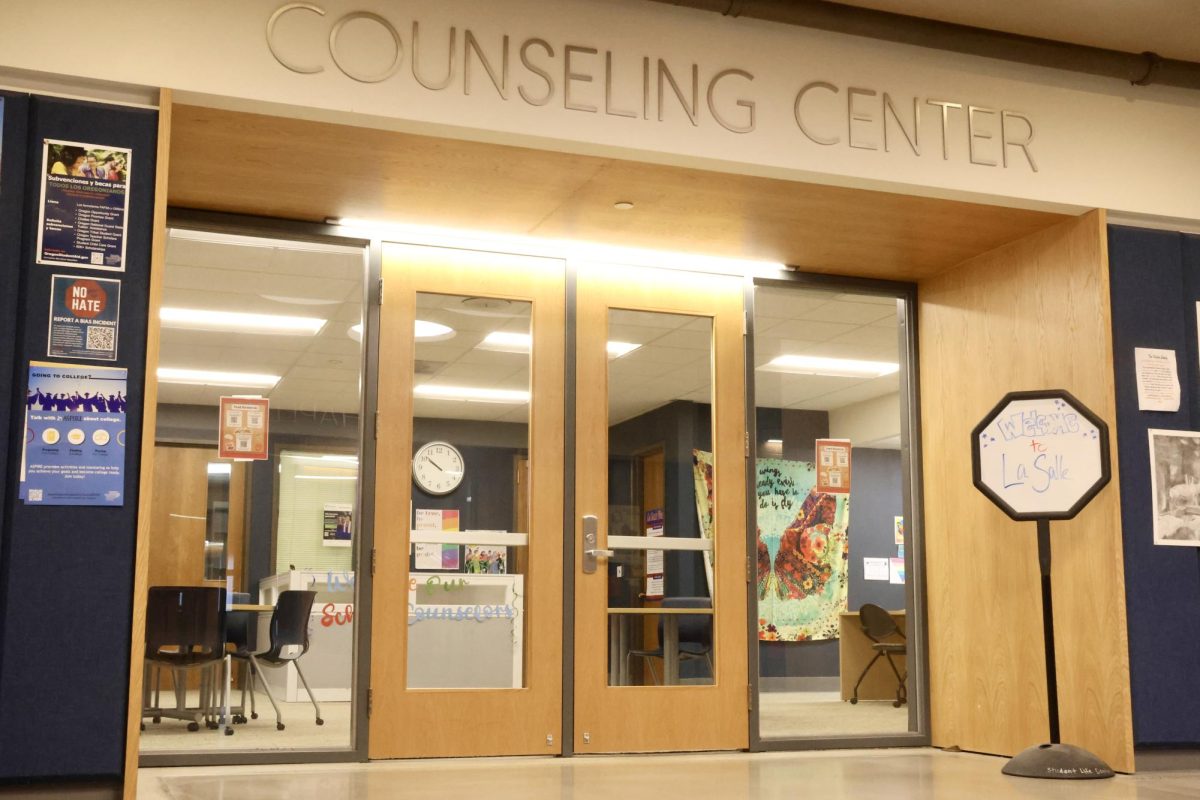
For the staff of La Salle’s counseling department, every day looks a little bit different.
By nature of the position, counselor Ms. Chris Babinec explained, flexibility is key. The daily responsibilities and tasks of counselors constantly fluctuate, depending on who’s dropping by the Counseling Center or the type of work that needs to be done behind the scenes, including communicating with parents and helping to create accommodation plans.
“The job is very dynamic,” Ms. Babinec said. “It really is so varied every day, so you have to come in being prepared to just take on whatever comes at you.”
On a day-to-day basis, this includes scheduled meetings with students and drop-ins. It ranges from supporting students experiencing a panic attack or other crisis to visiting classrooms and collaborating with the administration.
Overall, their role centers around acting as student advocates, counselor Ms. Michelle Berry and Ms. Babinec said. Their goal is to offer a space for students to discuss what’s going on in their lives, honestly and without fear of judgement or disappointment.
“Sometimes our families, the people in our lives, they want things for us or from us,” Ms. Babinec said. “They want us to be happy. They want us to do well. They want us to achieve our dreams and goals. I think every single human being needs someone in their life that doesn’t want or need something for them or from them.”
The environment provided by the counseling center — a place that’s designed to be separate from the weight of other people’s expectations — allows students to process what they want for themselves, Ms. Babinec explained.
“We’re here to support and really help kids identify who and how they want to be in the world, and give them the tools that they need to do that,” she said. “I think that the school counselor role is absolutely vital to having a healthy school atmosphere.”
The topics students bring to counselors are wide ranging, she said.
Everything that affects them, both inside La Salle and in the outside world, students talk to counselors about, Ms. Babinec said. That includes anything from conflicts with friends and academic anxiety to more serious concerns, such as loss, mental health conditions, community violence, lack of food, healthcare, or other resources, and experiences with racism or sexual assault.
According to Ms. Babinec, anxiety and depression are the top two things that they work on with students, meaning much of the counselors’ time is dedicated to focusing on mental health.
Nationally, Oregon was ranked 39th for youth mental health in 2025, indicating a high prevalence of mental illness and low access to care. Overall, anxiety and depression rates have risen steadily across the country for adolescents since 2008, sharply increasing in the wake of the pandemic.
“Anxiety rates are through the roof … and there’s no easy fix for that,” Ms. Babinec said. “It affects everyone in really small ways and in really big ways, because all of those small ways add up.”
Anxiety and other mental health conditions impact not only a student’s overall well-being, but their motivation, ability to form friendships, and capacity to show up in the classroom, Ms. Berry explained.
Because of this, the counselors work not only to support students directly but also to help other members of the community, such as teachers or a student’s parents, understand what they are experiencing.
“It’s not just a little passing feeling,” Ms. Berry said. “It can be really debilitating.”
At a school like La Salle, students often feel high pressures to succeed, Ms. Berry and counselor Ms. Megan Huynh said. While Ms. Berry explained that she’s seen anxiety rise overall in her work at schools since COVID-19, she’s observed a particularly high number of students wrestling with it in the La Salle community, in part because of the stress and expectations they face.
“I would say I’ve had more students here in intensive outpatient type treatments or impacted day to day by anxiety than I’ve ever had before,” she said.
Students often internalize this experience, Ms. Berry said, blaming themselves for anxiety or stress rather than seeking help or working to create more balance in their life.
“I spend a lot of time telling students, ‘you’re not poorly managing your time, you just don’t have enough time to do all the things that you signed up to do, so something’s got to give,’” Ms. Berry said. “Unfortunately, sometimes what gives is their mental health.”
Ms. Huynh echoed this, explaining that though the sacrifice of personal well-being for academic success is a common trade off, it’s not one that’s healthy or sustainable.
From the perspective of a counselor, she said, what matters most for her is students’ overall health and happiness, in and outside of school.
“We have students that are academically driven and doing amazing, and for me, it’s like, ‘if you have a C and your basic needs are met, that’s all I could ever ask for you,’’’ Ms. Huynh said. “I want you to be a kid.”
Aside from academic stressors within La Salle, the broader stigma around mental health and asking for help is something that Ms. Babinec worries about, particularly its impact on students who could benefit by reaching out to a counselor.
“Some kids are really struggling and they’re afraid to say it,” she said. “That, for me, is the most concerning thing, because if you’re afraid to talk about it, and you don’t get the right resources, then you start to internalize this idea that there’s something wrong with you when there isn’t.”
Although they work to support students across a wide variety of concerns and challenges, both Ms. Berry and Ms. Babinec said that school counselors do not provide therapy, a misconception that they see sometimes deterring students from meeting with them.
“Our job is not to be therapists,” Ms. Berry said. “Our job is to help make sure students get referrals so they can get the care that they need, if it’s mental health, if it’s trauma support, if it’s medication, whatever it is that they need.”
In addition to concerns surrounding mental health, one of the largest issues that the counselors see in terms of school culture is harmful treatment and language directed at women, people of color, and the LGBTQ+ community by some members of the student body.
“Kids come in and talk to counselors about their experiences of racism and sexism and homophobia here at La Salle,” Ms. Babinec said. “I’d say at least once a week, if not more, we are talking about an incident where either a girl felt uncomfortable with some kind of behavior from boys, or there was a racist comment, or something like that.”
How to improve that is an ongoing discussion, Ms. Huynh and Ms. Babinec explained, one often brought up at Student Support meetings, which include the entire counseling department, Vice Principal of Academics Ms. Kathleen Coughran, and Dean of Students Ms. Kenzie D’Ambrosio.
For Ms. Huynh, much of what she hears about from students is how those experiences weigh on them.
Students have expressed to her that they hear microaggressions on a daily basis, and are silent in response to them or other racist comments because they don’t feel like they can object as the only person of color in a group of white kids, she said.
That experience can affect not only students’ well-being but how they show up in class and interact with peers, Ms. Babinec said.
“There are kids that come in, and they’ll say ‘every time I have to walk into a classroom, I’m looking to see is there a safe person for me to sit next to, or is there a way for me to avoid people who have hurt me in the past, or who have hurt a friend, or who I know have hurt other people through being racist or sexist or homophobic?’” Ms. Babinec said. “It can be really challenging for kids.”
Building a community where those students feel safe is one of the most important things for Ms. Huynh.
However, that sense of safety can easily be unraveled by seemingly harmless comments students make, intending to be humorous or portray different communities and groups of people in a specific way.
For example, when attending athletic events at schools such as Parkrose High School, some students were “joking about, ‘oh, let’s hope that we don’t get shot there,’” Ms. Huynh said.
While intended as a joke, those kinds of offhanded statements can have deeply negative ripple effects, she said.
“There are really, really great kids there,” she said. “That’s a community that’s strong and powerful, and I think that’s a community that several students interact with and have an idea or judgment [of] ‘they’re less.’ There’s an emphasis on the race of a lot of those students, whether it’s playing against them in sports, or going over there making comments about safety. It’s seen as light hearted when it’s really rooted in harm.”
Ms. Huynh, who grew up in the Parkrose area, explained the long-lasting impact those comments leave, not just on communities La Salle interacts with but on members of the school itself, including staff and students.
Far from upholding the school’s core values, such as respect for all persons, it tells students at La Salle who are part of that community that they’re not welcome, she said.
“A big part about being Lasallian is being a big brother and big sister,” Ms. Huynh said. “There’s a lot of students that have the potential to grow and be kind and respectful adults that can do wonders in society, but it’s comments like that where I fear that if there’s a student who lives in that community who hears that every single day, they never, ever will feel comfortable and safe here, because there’s always an idea that they may be a threat, they may not be enough.”
Ms. Huynh, reflecting on her own upbringing, expressed that she has a lot of empathy for what some students are going through, and wants them to know that there is no expectation to talk to her, but that her counseling office is a safe space.
“It’s hard,” she said. “It’s hard to share the harm that’s been caused to you and feel heard and seen. It’s hard to say it in front of somebody else and not feel like they’re judging in the moment.”
Beyond microaggressions or harmful statements from other students, the lack of representation among La Salle’s faculty can affect the sense of belonging that students of color feel at the school, Ms. Huynh said.
“A lot of students of color will just come to me. They don’t know me, they haven’t had a conversation with me, but they just want to be around me,” she said. “We have wonderful faculty that are kind and inclusive, but for our students who may feel isolated and don’t feel naturally safe, they may gravitate towards someone like me, or someone like Mr. Peoples or Oey and so forth.”
Both Ms. Huynh and Ms. Babinec emphasized that these issues aren’t unique to La Salle.
Students can often be made to feel like what’s going on is a problem with them, but it’s not, they said. According to them, it’s a systemic issue, and as schools often reflect society, it’s one that shows up in La Salle’s halls.
“I think no matter where you go, whether it’s a school or a business or a home or community, this is work that is always under construction,” Ms. Babinec said. “We’re still in that space of trying to figure it out and trying to work together.”
Though she is hopeful that La Salle can work to build a more welcoming environment in the future, Ms. Huynh expressed that it can be discouraging to see the reality of some students’ daily experiences.
“We have so much potential to be inclusive and celebrate so many different things from students, and I think there’s growth coming,” Ms. Huynh said. “But I think it’s also tough being in a position of … hearing some terrible things, seeing terrible things, and just trying to have the patience and empathy to grow with students.”
Both Ms. Huynh and Ms. Berry emphasized that their goal when working with students is to foster conversations focused on accountability and growth.
Students are here to learn, Ms. Berry said, and that includes learning about the experiences and perspectives of people who are different from them.
“How as a school do we make sure we understand the racism that’s going on?” Ms. Berry said. “Because that’s more systemic than individual. It is individual, but we’re not disciplinarians, so our job is to support those students who have experienced racism or have experienced sexual assault.”
According to Ms. Huynh, one of the most important ways to support students is simply by listening.
“It is hard to be a part of a community that is hurting, but at the same time, if we are going to be better, we need to address the harm and the disconnect that is happening,” Ms. Huynh said. “What we need to do is have the ability to just listen and hear the experience and just respect the fact that this is someone’s feelings.”
Though she wants students to know that the counselors are always there as a resource, Ms. Babinec emphasized that it requires everyone in the community having these conversations and putting intentional effort in for real change to happen.
“We are always, all of us, trying to figure out how to create a more loving, inclusive society, whether that’s a small society, like the school, or a larger society,” Ms. Babinec said. “It’s on all of us, all adults in the building, to create a healthy, positive culture.”













Tristan • Feb 19, 2026 at 8:04 am
Thank you for highlighting the vital role the counselors at La Salle play and the incredible work they do to support the student community. I hope this encourages anyone who may be struggling to reach out and get the support they need.
Jessica Guadagna • Feb 19, 2026 at 7:10 am
Thank you for this. It was a very illuminating article to read. We need to keep facing these difficult subjects and I appreciate the student journalists bringing these issues to light. I am also very glad we have very skilled and hard-working counselors and staff. Good job everyone!