

It was a cold winter night, just after 1 a.m. A woman walked out of the hospital that she said had just denied her service — only she was not headed home.
Because at that moment, there was nowhere for her to go.
Exiting that same hospital was senior Rissa Stone and her mother, who picked up the houseless woman described above and drove for over an hour to find her a safe haven.
“They’re just living their life,” Stone said.
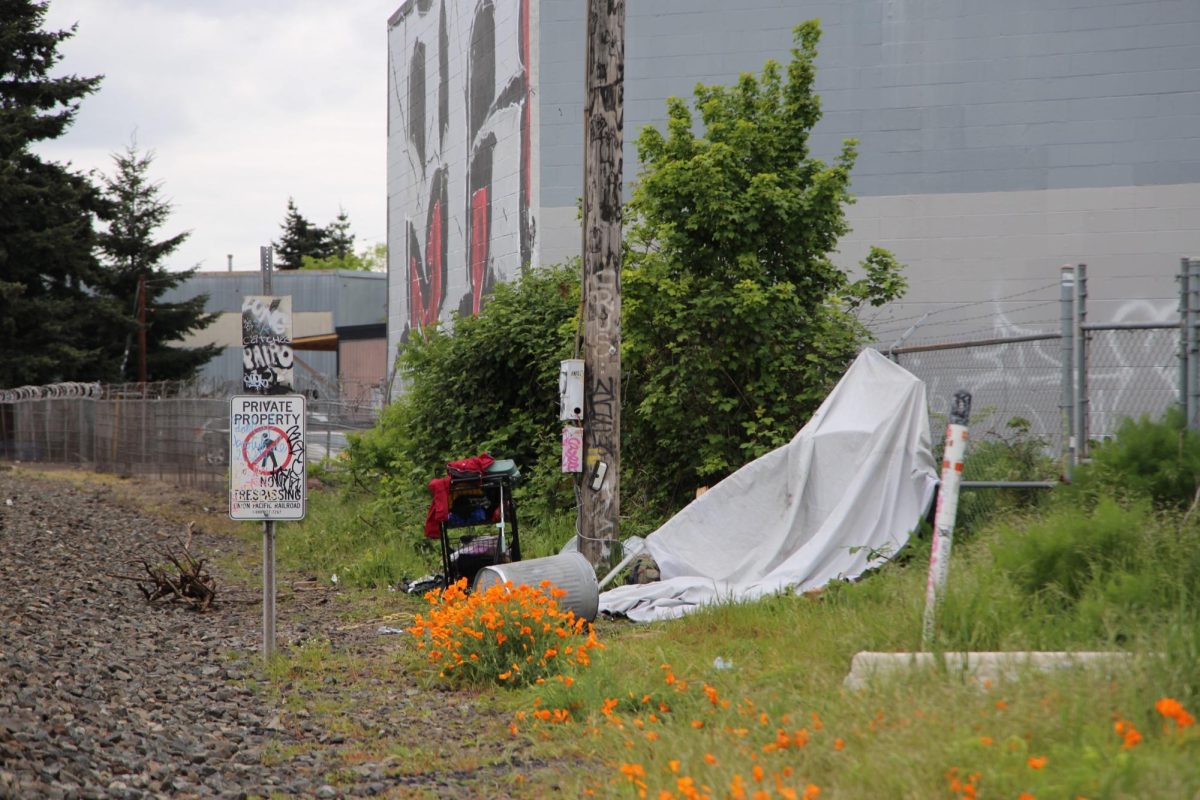
This is just one of the many stories of those living houseless on the streets of Portland and its surrounding areas, with thousands struggling every day as the rate of houselessness continues to climb.
As houselessness increases, its impacts are being felt as well throughout the La Salle community.
For junior Gus Zins, the neighborhood of Foster-Powell, which he once felt was quiet and peaceful, is now often a source of crime and disturbance.
“My neighbor got their bag stolen, and we have it on camera,” he said. “My dad’s got his trailer stolen three [or] four times.”
Sophomore Caelyn Cade observed the issue herself when running for both the cross country and track teams, saying it can be scary, “especially being a kid and by yourself.”
With this rise in interactions and issues, these students feel that lately, there has been a lack of effective action addressing the houselessness crisis.
“I do think that our mayor has gotten better at cleaning up the streets,” said Stone, who lives in Portland. “But not necessarily helping these people have better lives.”
Several students and staff members have chosen to respond to the ongoing homelessness epidemic by volunteering and doing service for their communities.
“[It’s] a problem that needs to be fixed, but it’s going to have to take a lot of time and effort,” freshman Lexi Dilbeck said.
Cade echoed this idea.
“It’s up to the individual to decide whether or not they’re going to be empathetic and try and help the issue,” she said. “I feel like it’s your responsibility to help people around you.”
In the case of Religious Studies Department Chair Mr. Edward Kendrick, he engages in service through multiple hands-on outlets like the Blanchet House and the Catholic Worker.
While he hasn’t helped at the Blanchet House this school year, in the past it has been a place where he found value, he said.
“The thing that always stands out to me about Blanchet House is seeing it as [a] restaurant [where] people are served their food, rather than going up with the tray like a cafeteria style,” he said, adding that the quality of the food is also high.
Zins hopes to become an ambassador for the organization in the future, as he has been an active member in the organization and plans to continue his volunteer work this spring.
Regarding his experience helping there, Zins said that “it’s definitely a positive thing, kind of putting people on the right track. I’ve heard many homeless people talk about how it’s helping them, and they’re making a comeback.”
Stone also supports the community through service, especially when things get more difficult as the seasons change.
“Me and my mom in the winter create hygiene kits for the houseless, and we go around and hand them out,” she said. “People are normally really thankful.”
For Zins, work towards addressing houselessness has been greatly needed for some time now.
“For four or five years, [the government] definitely [could] have done better,” he said. “They didn’t really do anything.”
This increase in houselessness rates has accelerated following the COVID-19 pandemic, which contributed to skyrocketed housing prices and posed a challenge for affordable housing options.
While there have visibly been less tents, that is not to say that the rates themselves are actually lower, despite Portland Mayor Keith Wilson claiming so.
And while students like Stone, Zins, and Dilbeck expressed having seen an improvement on the issue, the lives of the houseless may not be filled with that same improvement.
Stone, who recently sat in on a Portland City Council meeting, heard firsthand various experiences of those struggling with houselessness.
During the meeting, some houseless went up and spoke on experiences in the shelters dealing with things like inadequate food or unsatisfactory living conditions, and in some cases, sexual assault.
“Even though the streets are cleaned up, the city’s not actually helping them go rebuild their lives,” Stone said.
This work through service is a good way to help, but these students feel more should be done.
When it comes to criminal activity, Dilbeck hopes that “when they’re caught, [for them] to have repercussions, because they’re just going to put them back out on the street and they’ll just keep doing it,” she said.
Cade’s ideas focus on a different aspect, claiming that the houseless need more at their disposal so they don’t just end up on the streets again.
“[We should make] resources more known and also available,” she said.
Awareness is spread in Mr. Kendrick’s religion courses, as well as multiple other available religion courses — especially those taken by juniors, which all follow a similar curriculum.
In his courses Catholic Moral Thinking and Catholic Social Teaching, Mr. Kendrick likes to draw from personal stories and experiences.
“If I have a personal experience, I try to share it,” he said, adding that these stories help to make the issue seem more real.
One story he shared was that to help a man get back on his feet, rather than giving him charity, he hired him to help work on a chicken coop.
In this course, he also teaches key Catholic Social Teaching ideas like solidarity and rights of the worker, in which he gives more on his own personal experiences and ties in the ideas of houselessness.
“One of the things that always stands out to me is [a] quote that just stuck in my mind from college that someone said: ‘If you want to serve the poor, become friends with poor people,’” he said, adding that it is good to see them as friends, rather than simply just someone being served.





Comments are moderated, and won't appear until they are approved. An email address is required, but won't be publicly displayed. The Falconer's complete comment policy can be viewed on our policies page.