


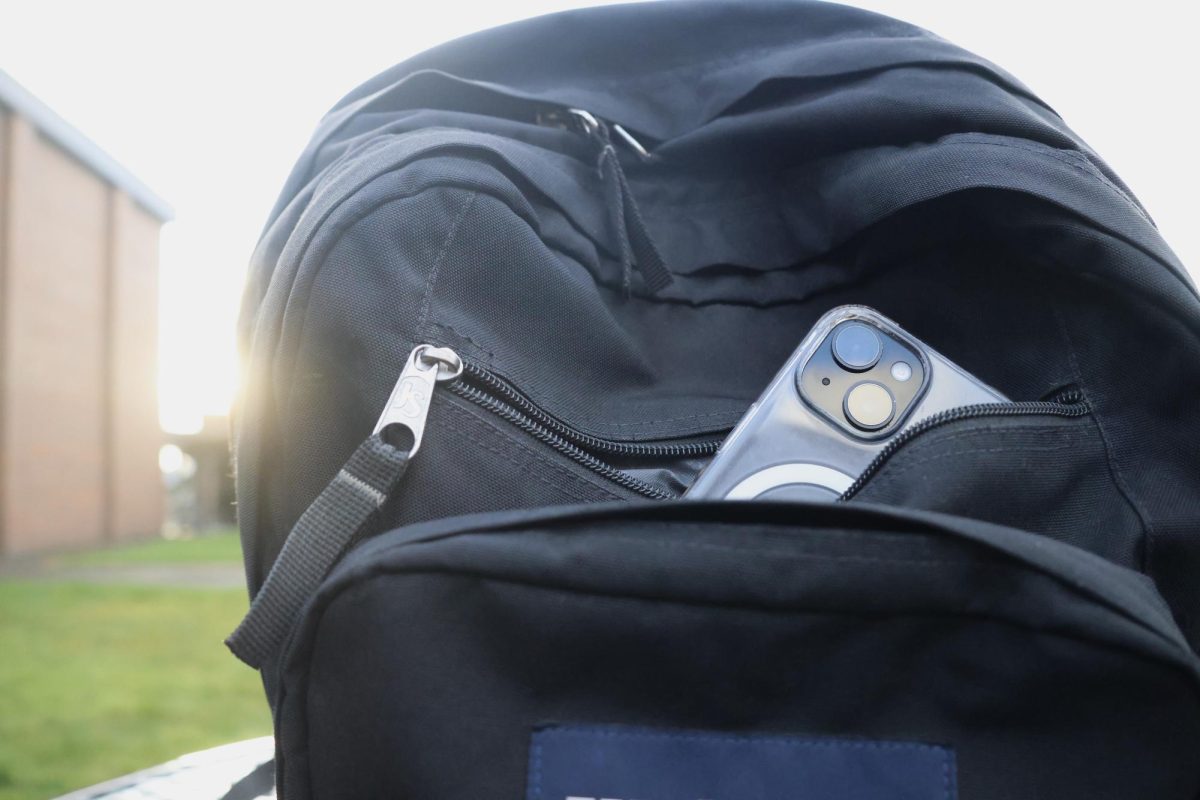
At the beginning of the 2025-2026 school year, La Salle joined all Oregon public schools and a growing number of schools nationwide in implementing no-phone policies during the school day.
As written, La Salle’s policy requires students to keep their phones in their bags from when they first arrive at school until the final bell.
Now, with the year drawing to a close, students and staff have begun to assess the effects of that change.
In the view of the administration, the policy was a long time coming, according to Principal Ms. Alanna O’Brien.
“If we want students to push their limits and receive a quality education, then we need to create environments at our school that allow for that,” she said. “Our goals were really to try and foster more human-to-human connection, create a healthier environment, and focus on academics.”
If a student is found with their phone out of their bag or in use during the school day, it is confiscated until the end of the school day, when phones can be returned to students from the Front Office. After three confiscations, the student must check their phone in at the start of every day at the Front Office and pick it up once the day ends.
In the 2024-2025 school year, though teachers were expected to instruct students to place their phones in caddies at the beginning of class, enforcement varied from classroom to classroom, and students were free to use their phones outside of class time, such as at break, lunch, or during passing periods.
The new policy marks a major shift, as now all visible phones are liable to be confiscated, and all phone use is prohibited throughout the whole day.
“It just seemed like a number of kids weren’t connecting with people — they were kind of more connected to their device,” Ms. O’Brien said. “In the idea of trying to foster a healthier environment where people are making human-to-human connections, we wanted to make a shift from not having cell phones in academic classrooms to just not having cell phones out all day.”
Of the more than 10 teachers spoken to for this article, a common consensus was that the lack of phones has made students more engaged with their peers, and that the policy’s standardized enforcement is a tangible improvement, even if hopes for more overall academic engagement often didn’t materialize in the face of continued iPad-driven distractions.
This issue of personal iPads having features — and potential for distraction — comparable to phones is something the administration understood going into the policy.
Ms. O’Brien said this was part of the motivation to switch to school-managed iPads for the class of 2029 and all future classes at La Salle.
She believes that managing devices, both phones and iPads, helps to keep students engaged in school and fulfill the ultimate goal, which she described as “learning and helping students develop purpose.”
But some teachers — especially those who had stringently-enforced previous policies — found that any lack of increased engagement they observed might also stem from how the policy wasn’t a significant change from their previous standards in the first place.
Religious studies teacher Mr. Noah Banks feels that in his classroom, and across the school in general, the standard went from a “90% ban to 100% ban of the phones at school,” he said.
Other teachers found that, at least in their classrooms, the caddy system was better at eliminating technological distractions than the expectation that phones were to be kept in bags.
“I think [a caddy is] just a clean way of just removing that stimulus altogether,” science teacher Mr. Ryan Kain said. “It removes that thought from my mind of even having to worry about [phones].”
However, some teachers and students had concerns about the efficacy of the phone ban in reducing distractions, as they found iPads provided many of the same opportunities for distraction as phones.
“I feel a certain sense of futility about this policy … part of me wonders about the utility of getting rid of phones if we’re still allowing students to have iPads,” Mr. Banks said. “I had a student watching ‘Shrek’ in class today. [I] had to ask him to stop watching ‘Shrek.’ He said he was just ‘exploring his childhood favorites.’”
But even if it didn’t provide every desired benefit, teachers still agreed it was a real step in the right direction.
“There’s still a lot of students who are during class time doing stuff on their iPads that they shouldn’t be doing,” social studies teacher Mr. Peter Snow said. “But I think take any kind of progress you can, right? Baby steps.”
Even some teachers who thought that alternatives to the ban, like caddies, might work better in their classrooms found that the consistency the policy provides is invaluable.
“You see a phone; you take a phone; you bring it to the office,” Mr. Kain said. “As an adult in a space where you’re trying to maintain systems and boundaries and accountability, that flow is really nice and easy.”
Beyond academics, and in line with the administration’s goal of incentivizing human connection, students and teachers alike noted another positive outcome: the increase in socialization during lunchtime and break.
“I just feel like there’s so much more socializing that goes on during lunch and break that I don’t think we used to see,” campus health and safety monitor Mr. Mikel Rathmann said. “It feels like I’m back at the high school I went to.”
Several students also attested to this change.
“I think my lunches are a lot more fun and vibrant,” junior James Garone said. “I don’t have to fight between [my] friend paying attention to [me] or scrolling.”
Sophomore Christian Fleming echoed this, emphasizing the reinforced community outside of class.
“It got a lot better because at lunch [students are] not jumping on their phone and not talking to each other but actually interacting and forming bonds with each other,” he said.
At the same time, the policy created unexpected side effects for both students and staff.
Multiple teachers reported upticks in long bathroom breaks and students wandering the halls. Mr. Rathmann and several other staff members repeatedly confiscated phones when they stepped into a bathroom and found people standing by the sinks using them.
“I would say I have more students taking unreasonably, unnecessarily long bathroom breaks this year than I remember from years past,” Mr. Banks said.
However, other teachers haven’t seen it as out of the ordinary.
“I think we have less of that this year than we’ve had in the past,” English teacher Mr. Paul Dreisbach said. “I do think it has gotten worse more recently, but I also think that that is very typical of this time of year, where a lot of people are again tired.”
Another unexpected aspect of the policy was a large disparity between the number of boys’ compared to girls’ phones confiscated.
Main Office Administrative Assistant Ms. Sara Robles, who manages confiscated phones, said that it is “much more boy-oriented.”
In fact, of the 15 students who have had their phone confiscated three times — meaning they have to turn it in at the start of the school day — only one is a girl, Ms. Robles said.
While Ms. O’Brien recognizes students will need to learn to manage themselves in college and later in life, she believes that this external limiting of technology assists, rather than hinders, that development.
“My hope is that by the time they leave us and go to college, that they are more aware of the benefits of keeping their phone away and knowing when it’s good for them to have it out and good for them to have it away,” she said. “It’s protecting them when their brains are still developing.”
Ms. Robles repeated these sentiments and found herself even more convinced of the necessity of the policy after managing the phones all year and seeing the number of distracting notifications they produce. Experiencing that firsthand helped her realize the effect they might have on developing minds, she said.
“I have to literally put kids’ phones on airplane mode and turn their WiFi off and their Bluetooth off so that it stops buzzing at my desk,” she said. “It’s constant.”
Mr. Dreisbach wants to forefront student agency but similarly supports the policy, as he questions the ability of students — or anyone — to independently develop positive technological habits.
“I’m not sure the degree to which people in that situation are able to self-regulate without some sort of external force like a policy like this,” he said.
But one thing made clear by Ms. O’Brien and many other teachers is that the policy is about more than just making students be more academically engaged or limiting phone use.
“It’s not just a punitive measure to get you off your phones; it’s a real issue,” Mr. Kain said. “The way our brains are plugged in and wired is scary, and [it’s] only going to get scarier, in my opinion, which is part of the reason why you make a change like this. It’s student health and student betterment.”
Ms. O’Brien said that, at the moment, the phone policy is expected to remain the same in the upcoming school years with a small likelihood for change.
“Right now, I don’t see a reason why [phones] should be out,” Ms. O’Brien said. “There’s no research out there that’s advocating for that.”
And although the enforcement is currently external, Ms. O’Brien hopes students won’t always need that.
“At some point in the conversation, students need to realize the impact the technology has on them and make choices for themselves about how they want to use it and not have it be an external decision,” she said. “At some point, you want people to be internally driven to have a little bit more balance in their lives.”






Comments are moderated, and won't appear until they are approved. An email address is required, but won't be publicly displayed. The Falconer's complete comment policy can be viewed on our policies page.