



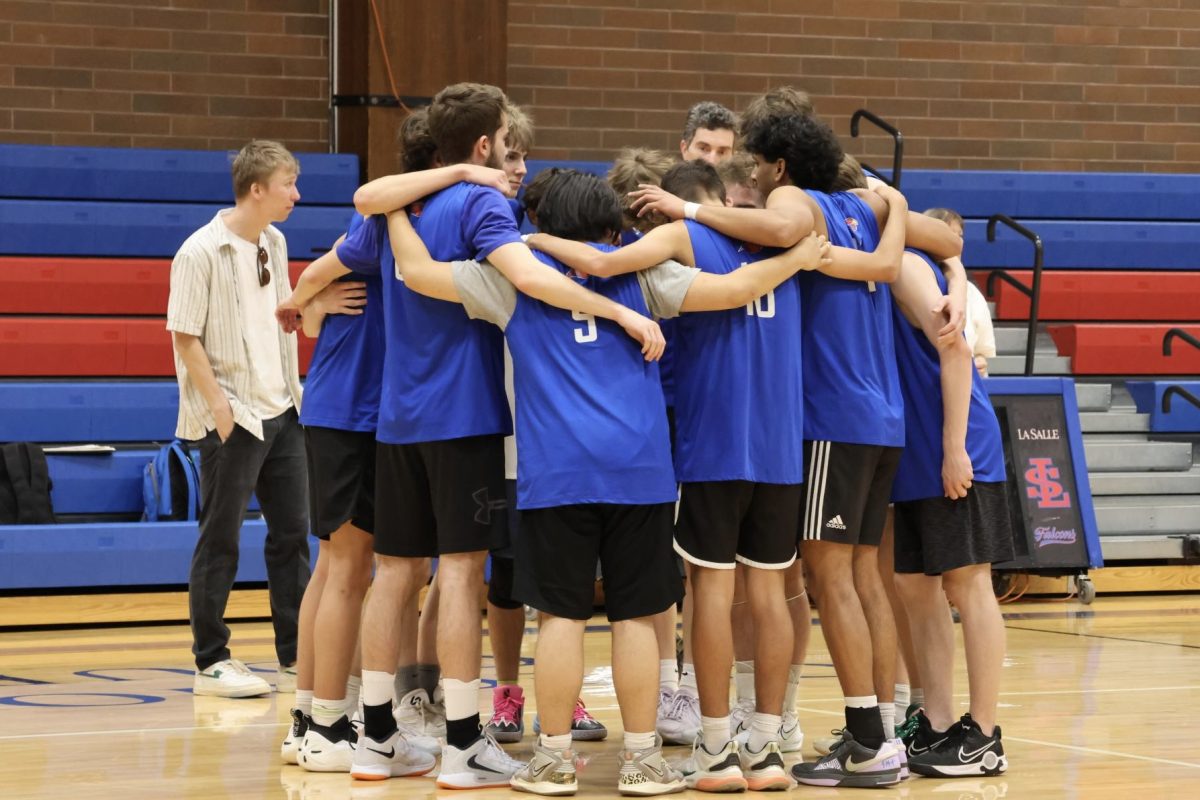
Just four years ago, boys volleyball did not exist at La Salle. There was no coach, no players, and no consideration for it.
Any students interested in the sport had to play for a different high school, which was the case for Tyler Smith ‘24, who attended La Salle but played volleyball for Clackamas High School, winning the state championship in his junior year.
“It didn’t feel as good because I wasn’t playing for my high school,” Smith said. “I was like, ‘Might as well start a team, talk to [Athletic Director] Mr. Chris George, and play for La Salle.’”
Smith reached out to Mr. George about starting a team at the end of his junior year, who said that it would be possible to get gym space for the team. They managed to find enough players to form a team, beginning play during Smith’s senior season in the spring of 2024.
In the team’s inaugural years, they were not sanctioned by OSAA and faced several challenges.
However, over the past three years, interest for the sport has accumulated across the state, resulting in the long-awaited OSAA sanctioning of boys volleyball on Oct. 6, 2025.
“I was ready for it,” head coach Denis Zhukov said. He attended the final sanctioning meeting on the 6th, and described the voting as “very emotional and exciting.”
Zhukov was formerly a club volleyball coach for Portland Chaos Volleyball Club, where he coached Smith and Evan O’Neil ‘26, two of his future players at La Salle.
It was O’Neil who approached Zhukov and asked him to coach the team at La Salle, which he agreed to do even though he would not receive a salary, as sports not sanctioned by OSAA are coached on a volunteer basis.
“The school was very supportive,” Zhukov said. “They organized the team, the parent committee voted for it, and then it just started.”
In their first season, there was enough interest from the student body to build a full team, but most players were new to the sport.
“It wasn’t an issue of [not having] people, it was just that we didn’t have skill,” Smith said. “Most of the team was new recruits who were just picking up the sport, which is great … but it [made] it hard to put a good team together.”
When Zhukov first accepted the job, he knew it would be different than coaching at club level, as he would be working with first-time players. He prepared himself in the months before the season, rethinking training processes and adapting drills.
Zhukov noted that the experienced players helped him with getting the new ones comfortable on the court and “familiar with the game,” he said.
“There’s a positive energy that comes from them that helps a lot with the new players,” Zhukov said, adding that the new players were “very hard workers.”
When boys volleyball wasn’t sanctioned, the end-of-season state tournament overlapped with La Salle’s graduation ceremony in early June, meaning that seniors couldn’t show up for all of the games.
Both Jack Gill ‘24 and Smith were seniors in the team’s inaugural season. The two had to go back and forth from graduation to the tournament games, missing some important ones.
Along with the tournament, regular season scheduling presented a significant challenge for the Falcons, which Mr. George described as “super difficult.”
“When you have established programs over multiple years, you know your scheduling process, and so there’s no indecision as to whether or not there’s going to be a team,” Mr. George said.
However, for boys volleyball, this was all different.
“People in all the participating schools were on their own timeline,” Mr. George said. “We’re trying to figure out if they’re going to have a team or not.”
Disconnection between schools and their boys volleyball teams was complicated to manage, since some schools scheduled their games through coaches and others through their athletic directors.
“It just means a lot more people you’re trying to network with, and so scheduling was a challenge to identify dates that work,” Mr. George said.
In their first couple seasons, La Salle competed in a league with teams such as Parkrose, Nelson, South Salem, Clackamas, and Cleveland High School.
However, due to difficulties with funding, a couple of these schools — such as Nelson and Cleveland, who had an established program last season and that La Salle previously played — will not be offering boys volleyball as a sport this spring.
“[Cleveland] had a good program,” Smith said. “It’s just ridiculous — I feel so bad for some of these schools that once [boys volleyball] became legal and allowed, they’re banned to play. I feel so bad.”
Additionally, in the 6A class, major school districts throughout Oregon, such as Beaverton School District and West Linn-Wilsonville, are opting out of the sport for the upcoming season.
Now that the sport is OSAA sanctioned, however, scheduling games will be much easier, as the Falcons will be assigned a league to participate in.
In addition to scheduling, funding was an obstacle in the first two seasons and required a lot of financial overview, with the goal of keeping things affordable. To figure out numbers and logistics, senior Jayden Gilbert and Smith met with the booster club, an organization led by parents which helps raise funds for teams.
“We … gave them the proposal of why they should help try and fund us,” Gilbert said. “Explaining that boys volleyball’s growing, it’s going to continue to grow, and there’s a lot more interest in it lately.”
Afterward, they got an estimate from the booster club of how much they would have to raise. They got money from players, worked concessions, and also went door to door asking for donations.
In previous years, the boys worked the snack shack during football games, using the funds to help those who couldn’t afford to play.
“Now that funding will hopefully go to new jerseys, new balls, things like that,” Gilbert said.
Unfortunately, for local schools lacking support and resources, boys volleyball’s sanctioning poses a problem in terms of finances, since this was decided in October in the same year of most schools’ budgeting cycle.
“Some of the school leaders are saying, ‘We can’t change our statutes in terms of how we fund this sport, that was already determined,’” Mr. George said. “The OSAA says, ‘That’s not our decision, we don’t involve ourselves in that.’”
Although things seem to be operating smoothly as of now, La Salle isn’t entirely exempt from these issues, according to Mr. George.
“Our goal, long term, is to be able to have it function like our other sports, but there’s an on-ramp to get there to make it affordable,” Mr. George said. “It’s awesome to be able to add [a sport], but you have to be able to account for that.”
While some problems might remain unsolved, the OSAA sanctioning of boys volleyball will still grant them some luxuries, scheduling, and transportation, as well as eliminating funding stresses.
The team has come a long way from where they first started, and their efforts have not gone unnoticed, Mr. George said.
“I applaud them for not giving up and continuing to push,” Mr. George said. “In order for stuff like this to happen, it does take a grassroots effort and people to commit, not really knowing what the future holds.”
This upcoming season, the boy’s team hopes to continue their competitive goals from previous years.
The team lost in a close match to eventual state champions Summit High School in the quarter finals of last season’s tournament, and plan to come back stronger this season.
“Everyone played really well, and everyone improved a lot,” Gilbert said. “This year, we’re going to come back and we’re going to win it all.”














Comments are moderated, and won't appear until they are approved. An email address is required, but won't be publicly displayed. The Falconer's complete comment policy can be viewed on our policies page.