



In November, world leaders gathered for the 2025 United Nations Climate Change Conference (COP30) to yet again agree on how humanity can avert the worst effects of the climate catastrophe we created.
They failed, again.
We already had the plan — we’ve had actionable plans for decades. Some, like the Paris Agreement, have even been signed by major nations, but in this instance we have once again failed to meaningfully change course.
This comes after the announcement in May that the world will almost certainly breach the 1.5 degrees Celsius warming limit set by the Paris Agreement to limit climate change’s most devastating consequences. In fact, average temperatures already broke 1.5 degrees Celsius above pre-industrial levels in 2024, but we know now 2024 will become the new normal.
And even if all nations that have green energy and climate targets stick to them, current emissions from uncommitted countries would still push the world’s average temperature above 2.5 degrees Celsius — not to mention that many nations don’t stick to their agreements anyway.
But the agreement at COP30 failed to even mention phasing out fossil fuel. Even as those countries already feeling the greatest effects of climate change argued for bolder action, wealthy and oil-rich nations repeatedly blocked all more meaningful progress, unless inadequate handouts without a concrete funding plan count as meaningful.
The United States didn’t even officially attend.
Here at home, you could be forgiven for forgetting about climate change amid the raucous bombardment that is the state of modern politics and our news cycle.
Among the Trump Administration’s myriad policy changes is a climate policy that seems dead-set on providing our grandchildren with only a burned-out husk of a world.
Perhaps this is unsurprising for a campaign given nearly $500 million in reported support from oil and coal lobbies — almost certainly a vast underestimate according to experts, as it does not factor in unreported support funneled through dark money groups.
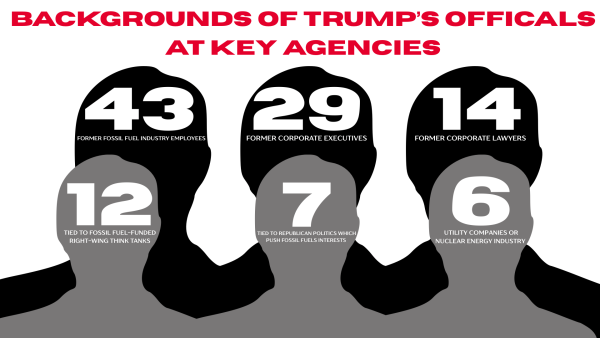
It’s unsurprising also for a campaign that upon entering office has elevated dozens of officials who directly worked for the oil industry to crucial government posts. This has been accompanied by the slashing of government funding for climate research and elimination of resources and datasets from agencies like the National Oceanic and Atmospheric Administration and the Environmental Protection Agency — not to mention the declawing of the EPA itself and total disregard for any green energy initiatives.
Let’s also not forget that, at this point, renewable and green(er) energy solutions are not only more sustainable but vastly more efficient and cheaper than oil.
But the Trump Administration disregards this.
The only mention in the modern Republican campaign platform regarding climate policy is, and I quote, “DRILL BABY DRILL.”
Climate denialism is resurging, but against the backdrop of war around the world and rising authoritarianism at home, it’s even easier to let it take the backseat.
So why must it remain at not only the forefront of our minds, but the forefront of the struggle to rebuild a better America?
To stop the collapse of our way of life and human civilization.
And it’s not just climate change: it’s the combined threat of climate change, resource depletion, and ecosystem collapse.
Right now — not the future, not in a possible scenario, but right now — millions die every year from human-caused air pollution, tens of millions face acute famine caused by drought attributable to warming climate, and hundreds of millions face increasingly violent and unpredictable storms coupled with rising sea levels.
Last month alone, half a dozen storms pounded southeast Asia in less than a month, leaving thousands dead and missing and causing the president of Sri Lanka — a nation of 25 million people — to declare it the worst disaster in his country’s history. These storms’ power and unpredictably were caused by our reckless disregard for climate consequences.
And they will only get worse.
Every year we use 1.6 times what our world can regenerate in a year’s worth of resources to fuel our way of life. The amount of resources we extract of all varieties is only increasing, and is projected to keep doing so.
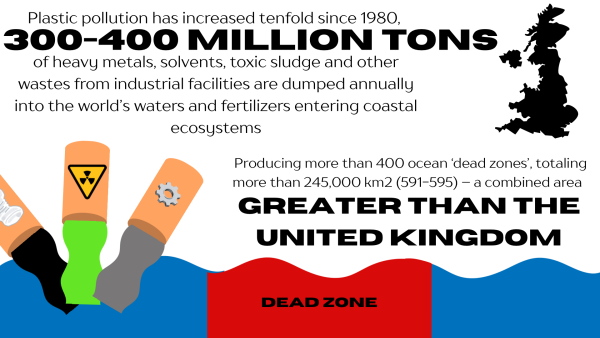
Plastic fills the seas and our bodies. Millions of species face extinction, our coral reefs are dying — even the entire ocean current that keeps northern Europe habitable are facing collapse.
This is only scratching the surface. To fuel our way of life, we are extracting vastly more than we can afford, killing billions of animals and humans to do it and slowly making our planet uninhabitable.
We are sacrificing our world upon an altar of profit and growth.
And it’s not just me saying this. Researchers, United Nations reports, activists — they all have pointed to one thing: we cannot measure our success by the profit margins of billionaires, and to save the world we need to do more than install solar panels.
Human wellbeing must be the goal — not profit, not pleasing oil-rich countries, not ease, but the survival of our species.
And no matter how many wind farms we build or electric vehicles we promote, we can never escape this crisis without that realization. Because while those things are cheaper, greener, and more efficient, at this point we cannot maintain our rate of extraction or usage with a fuel that is simply less polluting.
This is not only because we don’t have the capacity to build green energy at that scale, but because if human wellbeing does not become our priority, our solutions will always be incomplete.
It is already very late in the day. We cannot avert the worst consequences of our own arrogance — or at least there is no clear path to do so in today’s political world. But just as denialism and indifference assuredly doom us and our children, so does despair.
There never will be a time when action taken to protect human life and dignity right now, right here, will be pointless or harmful.
Such action, however large or small — even if it takes us another three decades to truly undertake it — can always save lives and always fortify our species and our world against the worst. The size of the challenge we face as a species, and the fact it only grows larger, is no excuse for inaction.
But it also seems clear that our political leaders — and our economic ones — are not only woefully unable to change course but encouraged by their own wealth and power to stay on the current path.
Change will only come through bold, mass action from the bottom up.
As our nation considers its future, as we decide what demands we will levy on our political leaders for our future votes and support, the assurance of a living world for our descendants must always be the first demand.











Chris Babinec • Feb 2, 2026 at 2:29 pm
With righteous outrage, and supporting data, this piece of writing is not just important- it is crucial to our survival.
My favorite points: “We are sacrificing our world upon an altar of profit and growth. “, “we cannot measure our success by the profit margins of billionaires”, and “Human wellbeing must be the goal…” capture the moral outrage and vast dimensions of inequality and lay bare the collective decisions our human cultures must make.
Do we continue to chase the accumulation or wealth and rugged individualism at our own peril? Or, can we learn from more collectivistic societies how to take care of one another and the planet simultaneously.