

With graduation just days away, seniors have one last hurdle to clear before walking across the stage.
The final task for them, as their high school career comes to a close, is to give a 10 to 15 minute professional presentation to a panel of teachers, staff, administrators, and possibly board members.
Here’s what to know:
What Are Senior Portfolios?
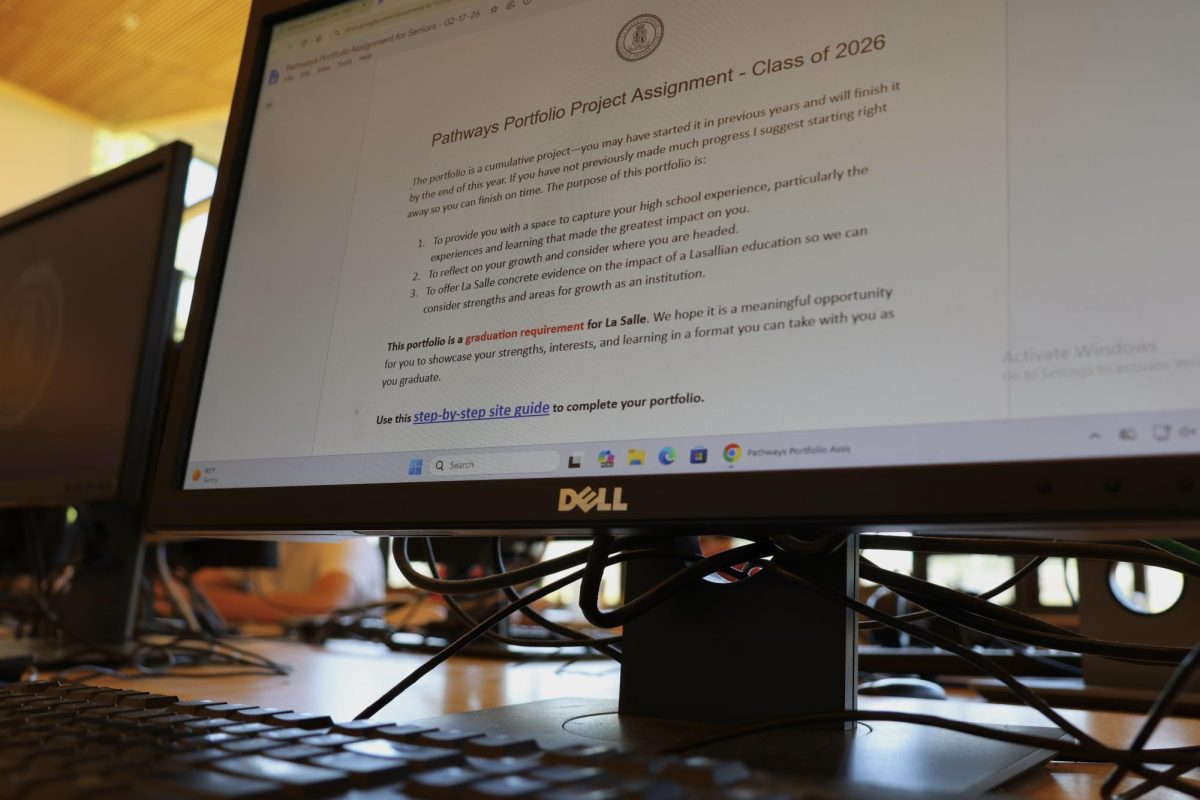
Originating in 2018, the Pathways Portfolio — commonly known as the senior portfolio — is the final academic project for La Salle seniors. Created on a Google Site, the portfolio includes examples of the students’ best work in each of their four years at La Salle.
In the portfolio, students speak to their personal and academic growth, plans for the future, and community service, according to Principal Ms. Alanna O’Brien. They are additionally encouraged to add pages about awards as well as extracurricular and cocurricular activities.
The portfolio — at its core — is “an opportunity for students to synthesize, curate, and showcase their high school experience,” Ms. O’Brien said.
Each year, freshman, sophomore, and junior students will be required to complete a portion of the senior portfolio, due in the last weeks of the school year. For completing the portfolio’s yearly requirements, students receive a quarter credit, according to Director of Academic Resources & Learning Initiatives Mr. Chris Long, who has directed the senior portfolios for three years.
This totals up to one full credit, which is required for seniors to graduate La Salle.
Toward the end of the year, seniors will express their preference of date and time for their presentation — a variety of timeslots from Tuesday, June 2 to Thursday, June 4 this year — to present their finished portfolio, with students that turn in the portfolio earlier receiving priority. The portfolios are presented to a panel consisting of two of their peers as well as at least three adults, Mr. Long said. The three adult observers are teachers, administrators, or board members who have signed up to watch the student present.
The presentation itself typically lasts around 15 minutes, Ms. O’Brien said, with 10 minutes for a portfolio overview and five for questions.
To help alleviate academic stress, second semester final exams for seniors have been replaced in large part by the portfolio, according to Ms. O’Brien, who added that the trade-off has worked well.
How Have Senior Portfolios Evolved Over Time?
Although the presentation aspect of the senior portfolio has remained relatively unchanged since the portfolio project’s introduction, according to science teacher Mr. Ryan Kain, the process for curating the portfolio has undergone changes under Mr. Long’s leadership.
In addition to minor logistical changes, one key difference in structure Mr. Long has accomplished was shifting the senior portfolio from a final cumulative project to a year-by-year reflection.
Previously, students would complete the entire portfolio during their senior year, pulling from their freshman through junior year archives to form a cumulative portfolio.
Three years ago, when Mr. Long took over the portfolios, the system changed to be a project students slowly chip away at year by year.
This was done partially to relieve stress on seniors, Mr. Long said, with the objective being that by spring of senior year, students will have completed around 75% of the project already.
“They’ll have much less to do by the time they’re seniors and much more time to focus on college and focus on the fun experiences, like the senior barbecue and graduation,” he said.
The transition was also made in an effort to curb student procrastination.
According to Mr. Long, around 20% of students do not turn in the portfolio by the final deadline — although failing to complete it altogether is rare — and the hope is that having yearly deadlines will make it easier for students to complete the portfolio in manageable pieces and not at the last minute.
Rollout for the four-year system has been relatively gradual.
The first year of the new system, instructions were somewhat vague according to Mr. Long, an issue which was fixed the following year with the addition of an asynchronous Pathways Portfolio course.
Starting this year, he said students who do not complete their grade level’s portfolio requirements will receive a grade of No Credit (NC) on their transcript, which can be made up the following year.
In addition to the divided workload, Mr. Long said that he has also searched for a way to make the portfolio a more memorable experience for seniors and for them to be able to receive comments.
“One of the first things I did was I wanted an authentic way for the people in the room … to give feedback to students,” he said.
This was accomplished by having adults take notes on a student’s presentation, jotting down positive takeaways and notes about the student’s identity, later handing these in to Mr. Long, who will place them in the student’s diploma to be received at graduation.
According to Mr. Long, the letters are a “beautiful way to send them off and show students that we really see them and care about them and [that] we’re excited for their next steps.”
What is Planned and What Would Community Members Like to See Change?
According to Mr. Long, the Pathways Portfolio course could be improved and has changes coming in the future.
For Mr. Long and Mr. Kain, a change that would improve the portfolio experience for younger students in future years is to have seniors have the option to present at Academic Showcase to show underclassmen what is expected of them and clear up confusion.
“One of the biggest pieces of feedback that I give, or comments that I make when I see them is [that] I wish more people could have seen this. I wish more people could have heard this, and I think that’s something that we can do,” Mr. Kain said.
Director of Campus Ministry Mr. Carter Powers echoed this desire for an increased audience, proposing that seniors have the opportunity to do a mock presentation for freshmen homerooms to provide a chance for extra understanding.
“Especially at the end of your freshman year … I think there’s a lot of insecurity,” he said.
Ms. O’Brien brought up a similar idea, stating that an improvement to the current system would be to have sophomore students present a miniature form of the portfolio, possibly to one adult or fellow students.
“I think that would be important,” she said. “That’s a midway point through high school and an opportunity for students to be reflective.”
Senior Evan O’Neil stressed that though the senior portfolio has, typically, replaced senior finals, some senior classes still often assign final projects due on the last school day.
“I have projects in every class, so it’s just like an eighth project,” he said.
However, Ms. O’Brien expressed that the portfolio — by itself — is not a significant workload, since it is made up of content that students have already produced throughout their years at La Salle.
“I don’t think it’s an incredible lift of academic work,” she said. “All they’re doing is curating, they’re not creating new content.”
Why Does it Matter?
This question comes up a lot, Mr. Long said, and when it does, he expresses the value of reflecting on past experiences and looking back at challenges that have been overcome.
“It’s kind of like a check in with yourself to say, ‘Hey, am I growing, am I developing, am I becoming the person that I want to become?’” he said. “That’s really valuable.”
Mr. Long noted that another reason as to why portfolios are important can be found in the name of the project itself: Pathways Portfolio.
The project allows students to be deeply reflective on their high school experiences and think about where life might take them next, which — Mr. Long stressed — is hugely beneficial for students.
Moreover, the contemplative aspect of the senior portfolio is crucial, according to Ms. O’Brien.
“I think it’s an activity where the process is just as important as the product,” she said. “Building a portfolio allows students to be reflective on their four years and bring everything together in one space, right before they graduate.”
Adding to this, Ms. O’Brien said that a senior portfolio is a gift back to La Salle in and of itself, giving La Salle valuable information about how they are educating students and what matters to those students.
“I feel like it’s important for us to be able to see the students who are graduating in a way that’s not a number,” she said. “It’s much more holistic than a test score or a GPA … it allows the student to tell the story of their high school experience, and I think that’s wildly important.”




Comments are moderated, and won't appear until they are approved. An email address is required, but won't be publicly displayed. The Falconer's complete comment policy can be viewed on our policies page.