

Due to a new requirement from the state of Oregon, La Salle students — and high schoolers across the state from the class of 2027 and beyond — will now have to take a financial literacy class in order to graduate, said Vice Principal for Academics Kathleen Coughran, the administrator spearheading the implementation of the new class.
“The state is requiring it,” Ms Coughran said. “As a school we also think it’s important and it’s what our students are asking for.”
To address the fact that a financial literacy class would cut into students’ elective time, La Salle is offering two options for rising seniors: a one-semester in-person course, or an online version over the summer through the platform Everfi.
“The Everfi program will be used for this summer, and then our hope is to roll out our own asynchronous course through Schoology in the future years that feels a little more tailored to our students and maybe a little more robust than this program,” Ms. Coughran said.
As of right now, no teacher has been assigned to the in-person course, though several have expressed interest, Ms. Coughran said.
One of these individuals is social studies teacher Mr. Peter Snow, who taught a financial literacy class in North Carolina where it is also a graduation requirement.
To Mr. Snow, a financial literacy course could be a good opportunity for many students.
“I look at this issue not only as a teacher, but also as a parent,” he said.
After noticing the struggles his recently-graduated son faced around life skills that could easily be part of a financial literacy course, Mr. Snow believes that despite the fact that it may be frustrating to lose more elective slots, skills like learning how to rent an apartment are necessary.
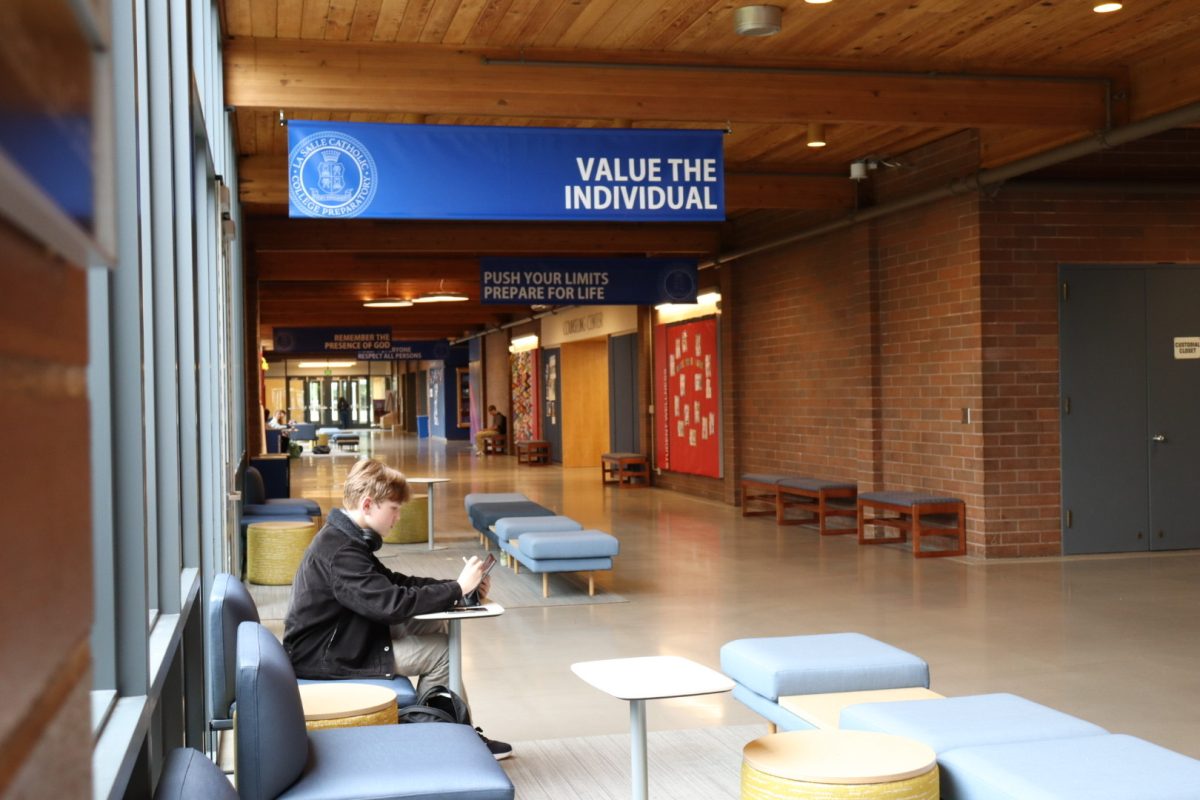
“‘Push your limits, prepare for life,’ it’s our banner. This is a part of that,” he said.
Reactions among students are divided, with many concerned about forecasting with another required class, despite the digital option.
For junior Max Shevtsov, who is currently writing a research paper on financial literacy for his English class, the issue of financial illiteracy is important.
“I’m happy that they made this class,” he said. “I’m happy that they have it required.”
However, he still feels that the class of 2027 should be exempt from taking the course.
“I honestly feel like a required financial literacy class would be a good thing,” Shevtsov said. “But right now, it’s just really bad timing for it … For instance, I have my schedule set. I already had nine different classes I was picking from, and I already had to sort them out, and then here comes across a new class that’s required, and now I have to do it over the summer.”
Junior Heremela Solomon had a similar point of view.
“I understand the need for it, and I understand why we have to take it,” she said. “I’m just more leaning on the requirement side, because a lot of people have spots in their schedule that they need to fill with other things.”
Sophomore Leonard Goldman was more skeptical.
“I think what would help is if I took the class later in life when I was in college,” he said. However, he expressed doubt that students would take it seriously because it’s required.
“It will make people who are taking it less likely to pay attention because they’re not taking it of their own free will,” he said.
While the exact curriculum won’t be finalized until a teacher is chosen, Ms. Coughran said the course has to follow guidelines set by the state of Oregon that include budgeting, banking, taxes, credit, investing, and financial planning.
Something that Shevtsov hopes the class can provide is access to reliable financial resources.
“I would like to have a set goal of being fully confident for the future,” he said. “The hardest part about all this financial stuff is where you can find your resources, and that’s something that I want to be able to be explored.”
Solomon is planning to take the class in person and wants to learn money management skills that will extend to life after graduation, saying she wants to go into college with “more of [an] understanding of what goes on in the real world outside of high school.”
Ms. Coughran is confident the class will be beneficial. “I think it’s always good for people to learn about what the real world will look like when you manage your own money and have to pay taxes,” she said. “I would have loved a class like this.”







Chris Babinec • Mar 19, 2026 at 9:19 am
Financial literacy is foundational to a healthy life. I am glad all students will benefit from exposure to this information. Though, I would also love Civics classes to make a resurgence in high school curriculums!