

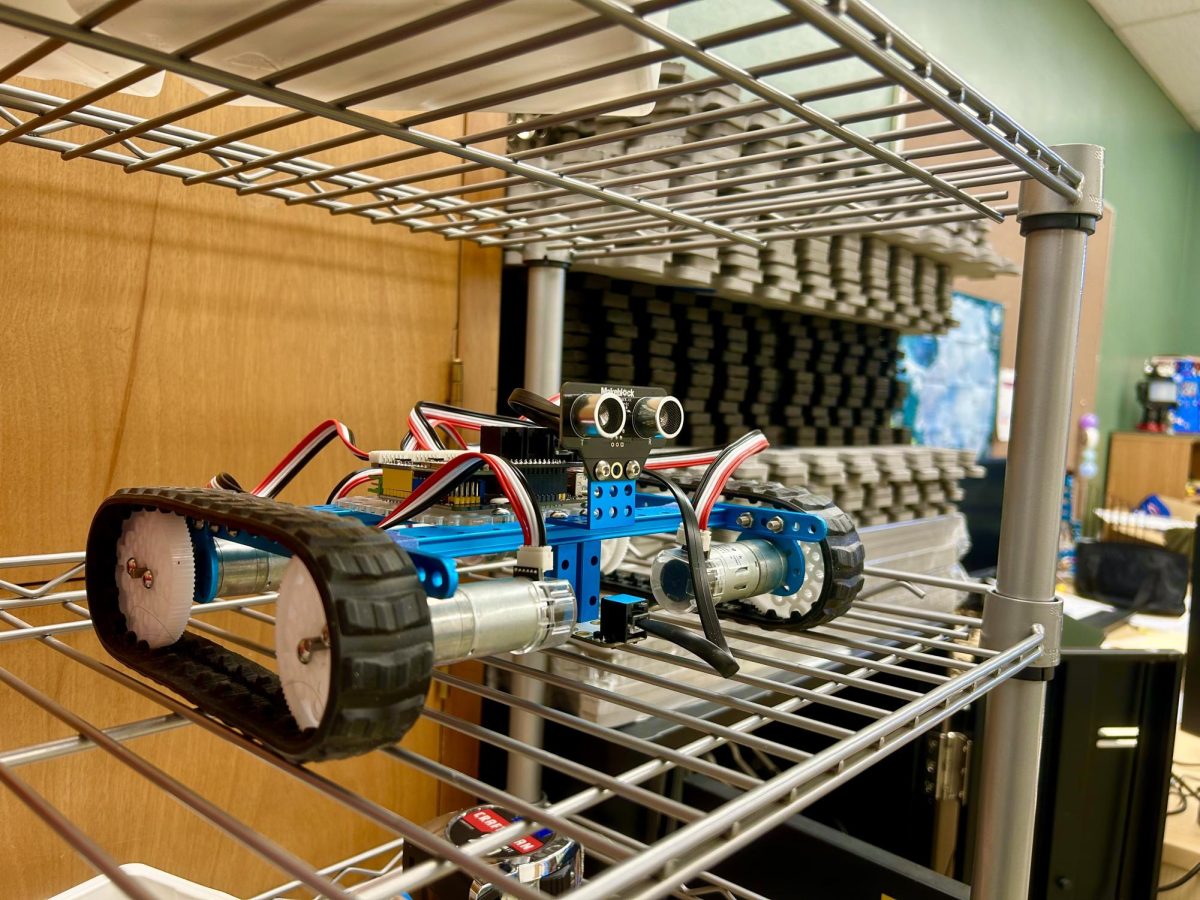
After a long-lasting hiatus, the robotics class returned at the beginning of the school year, featuring opportunities to branch out in code and bring engineering mechanisms to life through kits.
Led by Director of Computer Science & Robotics Mr. Aaron Milam, his goal and overarching passion are embedded in discovering what students are interested in so that they can carry on the innovation that comes with learning robotics, he said.
“Creativity is huge,” he said. “So you can let [students] pursue the interest threads that they want to pursue, and have as many self-study projects as possible.”
For Mr. Milam, robotics operates as “concrete extensions of the logic of computer science,” he said. After he earned a master’s degree in the subject through an online program during the pandemic, his hope was to go into video game development.
His interest started in video games with 2D simulation, having created his own projects as a pastime to bring his ideas — and his children’s — to life. However, that interest later evolved into pursuing a more physical, 3D connection with robotics. Similarly to how the code he wrote generated visuals on a screen, programming could prompt a robot to follow commands.
While making video games remains a fun hobby, teaching robotics became his profession.
He found that the job market had more roles for education than video game development, although he had no prior experience teaching high schoolers. Mr. Milam added that he was only hired a couple weeks before classes began, which made the adjustment more difficult, especially when deciding on the curriculum.
In the end, he recognized that the class was more “somewhere in between” a beginning and intermediate class in terms of difficulty — not Robotics 1, but Robotics “1.5.”
So halfway through the semester, the class was divided into two.
What originally began as a Robotics class turned into Intro to Robotics and Robotics 1 to address the learning curve and allow a chance to improve for students who weren’t performing as well, he said.
According to Mr. Milam, the initial class had a wide range of students and experience levels, which affected some students’ performance in class. He noted that many students had dropped the class due to its difficulty.
Because he wants the class to be more accessible for students, both Intro to Robotics and Robotics 1 will be presented as separate options next year, along with a robotics club he hopes to have finalized so that students can have more accessibility in their schedule, chances for help, and the opportunity to compete.
“The people who are finishing this class, they worked really hard to find a balance,” Mr. Milam said.
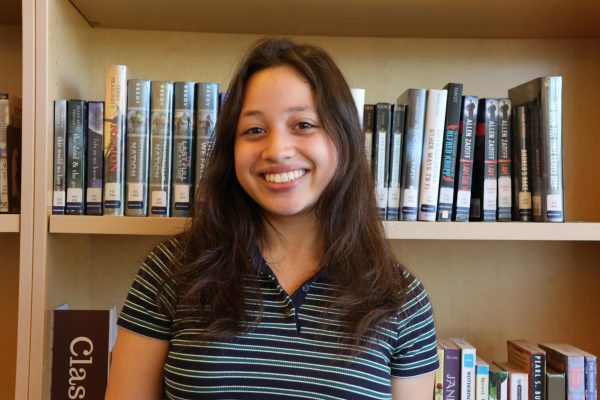
Freshman Bea Baker hoped to take both computer science and robotics this year; however, only the latter fit into her class schedule. As the main programmer for her FIRST Tech Challenge (FTC) team, a youth robotics program with many seasonal competitions, she already had coding experience, but not in the same programming language.
“It is still kind of difficult because I hadn’t known much about Python before and robotics, it’s very specific,” she said. “So even the bare minimum I knew before wasn’t even really relevant at all.”
Unlike the computer science and robotics classes at La Salle that are centered around Python, the FTC focused entirely on Java, Baker said, which she had to learn mostly on her own.
Baker’s observations about the difficulty of Mr. Milam’s class are echoed by freshman Henry Welsh. Though he took robotics in middle school, it largely consisted of “block coding” on a free online coding program called Scratch.
“This was a hard class,” he said. “Just because [of] the learning curve from never having written anything before to now I’m writing 200 lines of code.”
A significant difference he described between his robotics class in middle school and now is the attention to detail.
“You click run and it all works perfectly,” he said in reference to block coding. “Versus when you’re writing out lines of code, line by line, and you miss a comma in line five and then you’re to line 200, and it doesn’t work.”
That one discrepancy, he noted, takes time to fix since it’s hard to know where one messed up, but then — it works perfectly.
“This is like true coding,” he said. “It’s way more fun.”
His new knowledge of code has allowed him to start a project in his free time, a text-based puzzle game composed of an assortment of “if” statements, prompts, and around 350 lines of code.
“That knowledge of, I know how to code … in today’s world, that’s really almost valuable with all the technology,” he said. “Another tool I can have in my bag of life.”
Sophomore Max Elliott, who took a semester of computer science last year and started coding in fifth grade, wanted to do robotics for a similar reason.
“Robots are becoming kind of a big thing in our world, with AI growing, and it would be cool to code something that could make a robot do something automatically,” he said.
Elliott appreciated the opportunity he had to apply his knowledge of the real world through robotics, saying that although he knew many students struggled, it wasn’t a difficulty he personally faced — something he credited to the independence fostered from his previous school, Franciscan Montessori Earth School.
“It’s different than other classes because you still have to follow instructions and do stuff, but you get more opportunities to make decisions on your own,” he said. “I found myself searching stuff up on my own and trying to learn that way.”
According to Mr. Milam, he was hired to run the robotics program as a flipped classroom model, meaning that students have to learn content and complete assignments on their own time and come to class with questions as necessary.
Regarding this structure, Baker suggested that more in-class introductions to the assignments might help because it could make independent work less difficult for students.
“Generally, you had to do most of the stuff on your own,” she said. “Because in class, you’re going to almost exclusively be building the bot, unless you’re finished — then you’re going to almost exclusively be coding the bot and making sure it works.”
Overall, Mr. Milam hopes that as students take the class, they not only take away the “fundamental programming skills,” but the independence fostered in the classroom, he said.
This, he said, emphasized another critical aspect of robotics: creativity.
“The more tools you learn, the better you can express yourself,” he said. “Once you learn what your tools are and what they can do, it opens up the ability to be creative.”



Comments are moderated, and won't appear until they are approved. An email address is required, but won't be publicly displayed. The Falconer's complete comment policy can be viewed on our policies page.