


Last year, La Salle introduced reusable dishware, and since then, the kitchen staff, students, and some faculty have pioneered initiatives in an effort to create a greener cafeteria. But while some of these programs have succeeded, many of them, including reusable dishware, have been frustrated by student apathy and staffing difficulties, Kitchen Manager Ms. Megan Jones said.
For those on campus who consider sustainability core to being Lasallian, that’s a big problem, science teacher Mr. Matthew Owen said, especially since La Salle produces a lot of waste every lunch time — about 50 pounds a day, according to the food audit conducted in January.
“Being at a Catholic school, a big part is stewardship of the earth and taking care of our spaces and leaving our space better than we found it,” Mr. Owen said. “I think that that’s a pretty big call to action that we’re not living up to.”
Ms. Jones started the cafeteria’s transition toward reusable dishware early last year, and has worked with Mr. Owen, students in his Climate Science class, and members of Earth Club to try to get sustainability initiatives off the ground.
“I have been interested in sustainability my whole life,” Ms. Jones said. “I think just becoming manager, I felt like it was something that I could really be like, ‘This is my thing that I want to take on.’’’
The cafeteria staff obtained a grant, bought the dishware, planned the rollout, and prepared themselves to adapt to challenges as they arose.
But they emerged faster than they could have anticipated, Ms. Jones said.
Most devastating to the initiative, students were still throwing dishware away.
“They’re clearly not something you throw away, but we were getting 20 to 30 thrown away a day,” she said. “If we didn’t rescue them out of the garbage, that would eat away our reusables pretty fast,” she said.
Those numbers weren’t sustainable. To make matters worse, many people didn’t properly bus their trays, stretching the kitchen staff even thinner in terms of dish cleanup.
Still, students from the Earth Club and the Climate Science elective did what they could to support the initiative.
“We worked on a lot more signage, and … leading by example,” senior Audrey Waters, one of Earth Club’s leaders, said. “[We were] kind of working with them on how to make that most efficient, so … they’re still able to do their tasks that they’re paid to do and have it not be a huge burden for them to implement.”
But with the start of the 2025-26 school year, even more dishes were being thrown in the trash, and the parent volunteers the kitchen needed to continue supporting the program were not materializing.
So the dishes were shelved, Earth Club stepped back to focus on creating a new generation of club leaders, and new attempts to create interest still aren’t succeeding, Ms. Jones said.
“Every time we think that there’s a solution, nobody shows up,” she said. “I don’t know how to change that.” The cafeteria still has the capability, it just needs engagement, she said.
“We have all the means to be able to use them — physically they’re here, we still have the carts, we have everything to do it,” she said. “We really just need student help, and we need parent help.”
And for many of those who hope to promote a more healthy consideration of the environment, the setback is dispiriting.
“If you can’t take care of your own space and the things that you use, that’s a concern,” Mr. Owen said. “It’s pretty unfortunate because as a school, where we’re trying to be greener, we’re trying to promote good habits that hopefully we can carry out beyond these walls when students leave and be aware of the waste that we create.”
But the setback of that major initiative doesn’t mean others are not still trying to make a greener campus, even if indifference remains, said Mr. Owen.
Of the tons of waste La Salle generates from the cafeteria each year, nearly 60% is compostable, according to the January audit. As their final for Climate Science, seniors Leo Hartley and Alex Sale wanted to reduce that percentage.
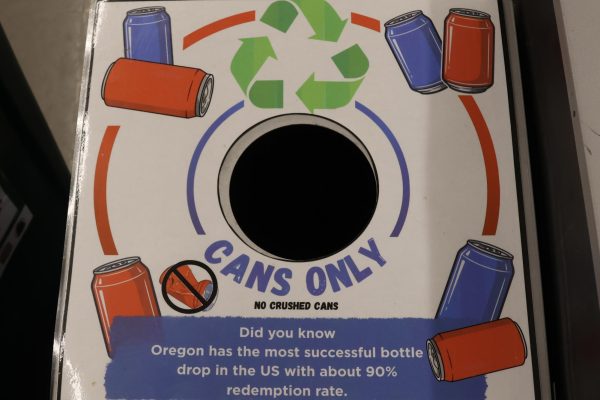
They got the compost bins functional again, made announcements, created more signage, and worked to set a good example.
“Overall, I see a lot more people composting than there was before, and I think students have started to warm up to it,” Sale said. “At the start, I was standing in front of the compost bins, and I had somebody look me in the eyes as I told them, ‘hey, please compost that,’ and throw everything in the trash. So I think it’s gotten better … but it still has a ways to go.”
Even after their efforts, the amount of compost collected every lunch has again begun dropping since they worked on their project, Ms. Jones said.
Still, change is happening, if slowly, according to Ms. Jones.
On the backend of the cafeteria, every day all the leftovers are either given to staff or taken to charity. All the kitchen staff’s waste is properly disposed of, and more parent volunteers are coming more consistently as the year progresses, according to Ms. Jones.
And last year, other Climate Science students pushed for the elimination of single-use condiments. After an in-depth cost-benefit analysis, they successfully lobbied Ms. Jones to buy the condiment dispensers using last year’s grant.
“What I really want students to know, what has been in my head all semester, is you are so much more capable of making change and doing things than you think you might be,” Mr. Owen said. “And that group just took it on, and I see those condiments, the condiment dispensers in the cafeteria, and I think of those three every single time.
But whether future initiatives will gain ground, and whether the hopes of staff and students trying to create a greener campus will succeed, remains to be seen.
“There’s some of us that are very aware and then some that aren’t,” Ms. Jones said. “How do you teach [awareness] to people where they are accepting of it and want to listen and care?”





Chris Babinec • Feb 27, 2026 at 2:14 pm
Taking care of our planet is not just the moral thing to do, it is also a wonderfully selfish act. Without good stewardship of our resources, we all suffer. My sincerest hope is students become more aware that as they take care of the Earth, they take care of themselves. I also hope the efforts of our kitchen staff are not only appreciated, but respected.