

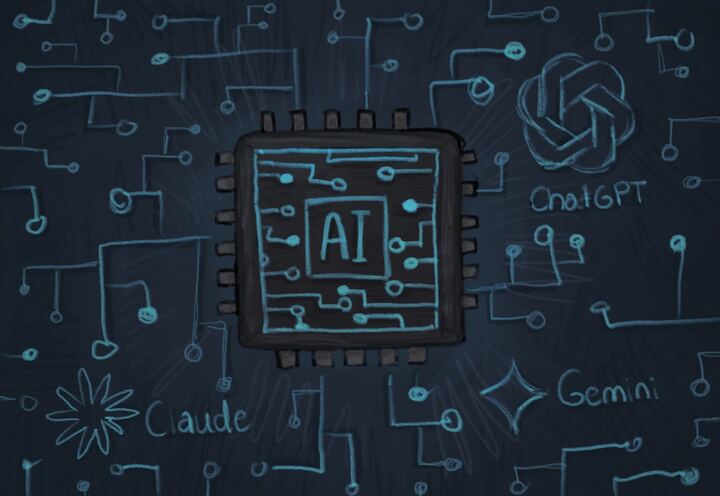
Given its rising usage by students, it is clear that the utilization of AI in academic environments is becoming more and more relevant.
From January to May of 2025, students’ use of generative AI for schoolwork grew from 79% to 84%, according to the College Board Newsroom. This can include using it to edit or revise essays, conduct research, brainstorm ideas, help with assignments, or provide study assistance prior to exams.
As the use of AI grows in the community, students at La Salle are feeling the effects.
“I feel like it just impacts us as a whole,” junior Trent Earls said. “It can really help us learn, or it can be a negative thing too.”
Senior Nur Hannosh did a statistics project on how much students used ChatGPT for academic purposes, surveying two pools of 26 students, one of whom was questioned anonymously and the other whose names were recorded.
According to her project, 80.8% of anonymous students said they use AI for help sometimes or often, while 57.7% of the students who were not anonymous reported utilizing AI sometimes or often.
Overall, students mainly use AI to assist them with their academics.
Students will often have chatbots make study guides, quiz them, ask them questions, or explain confusing topics in a way they will understand, according to both Earls and senior Alexa Storie. Additionally, more teachers at La Salle are allowing students to use AI for studying and preparing for assessments, Storie said.
In religion teacher Mr. Noah Banks’ Christology and Paschal Ministry class, sophomore Madalyn Bamberger said she uses AI to check her knowledge in preparation for tests.
“I use it for clarifying questions — kind of rewording things — so that it’s easier to write and express what I’m thinking,” Bamberger said.
Hannosh echoed Bamberger’s experience, saying that some of her classes try to directly “implement it.” Additionally, she expressed the positive impacts that AI can have for students, especially with how much support it can offer for gathering and understanding information.
“I think it’s really helpful when you have something where you have to research lots online and summarize a bunch of things,” Hannosh explained. “AI can summarize and explain it easier for your own studying.”
On all AI models, such as ChatGPT or Google Gemini, the chatbots must be prompted with questions or topics prior to helping a student with what they have requested it to do. However, with NotebookLM, a student can simply click a button to generate podcasts, videos, infographics, and more.
Earls mentioned that science teacher Mr. Ryan Kain allows students to use AI to an extent for preparation on their Honors Biology exams. He explained that they have to use a specific prompt, telling the AI to help them think rather than simply give the answer.
In addition to studying, some La Salle students use these AI platforms and chatbots in creative ways that can be enjoyable to explore, freshman Kasia Marks said.
“Sometimes it’s also fun to use it for other things like generating images,” Marks said, who likes to use the Lovart image generator, which can generate images when given different prompts and can be an innovative way to further explore different AI platforms.
However, while there are positive features, Marks emphasized how students’ work ethic can be “negatively” impacted by the new era of artificial intelligence — eventually, “you just learn to use AI for everything,” she said.
Overuse of AI platforms can lead to time management struggles and affect the execution of students’ future academic work, Marks said.
“It’s really easy [to use AI], so it won’t take too long, and then you don’t learn how to manage your time,” she said.
For the most part, AI use is limited in classrooms, said junior Thuyan Nguyen. But to improve its use, students have suggestions about how to use AI responsibly in a way that is reflective of academic integrity.
Sophomore Bradley Weber noted that teacher-set guidelines could help guide students to utilize AI in a way where they understand the necessary ethical boundaries.
“Teachers can tell [students] what to ask it or tell them what assignments they can’t use it for,” he said.
One way to be protective of authentic processes is to stay aware of the negative repercussions, students said.
“We should keep the mindset that AI should be here to help us and not just give us the answers,” Earls said. “In the long run, we might become dependent on it.”
Nyugen echoed that thought, noting the distinction between using the new technology as a tool and using it as a crutch.
“I think AI is a great source of learning, but don’t use it to the extent where you’re taking advantage of it,” Nguyen said.
Storie shared how she thinks the future impact of AI on younger generations will depend on the circumstances.
“I think that it could help advance a lot of technology for us, medically, and in the work force,” Storie said. “It’s all based off of intention.”
Correction: Monday, Jan. 12, 2026
An earlier version of this article incorrectly identified the artist for the feature image.
![According to junior Katie Liu, Blue days are superior to Red days. “[Because of one lunch], I see that communities come together, there is more time for clubs to meet; I see people hang out with their friends that sometimes they're separated from because [of] A lunch or B lunch, and opportunity for more people to interact that usually wouldn't happen,” she said.](https://lasallefalconer.com/wp-content/uploads/2026/06/405A7815-1200x800.jpg)


Comments are moderated, and won't appear until they are approved. An email address is required, but won't be publicly displayed. The Falconer's complete comment policy can be viewed on our policies page.