

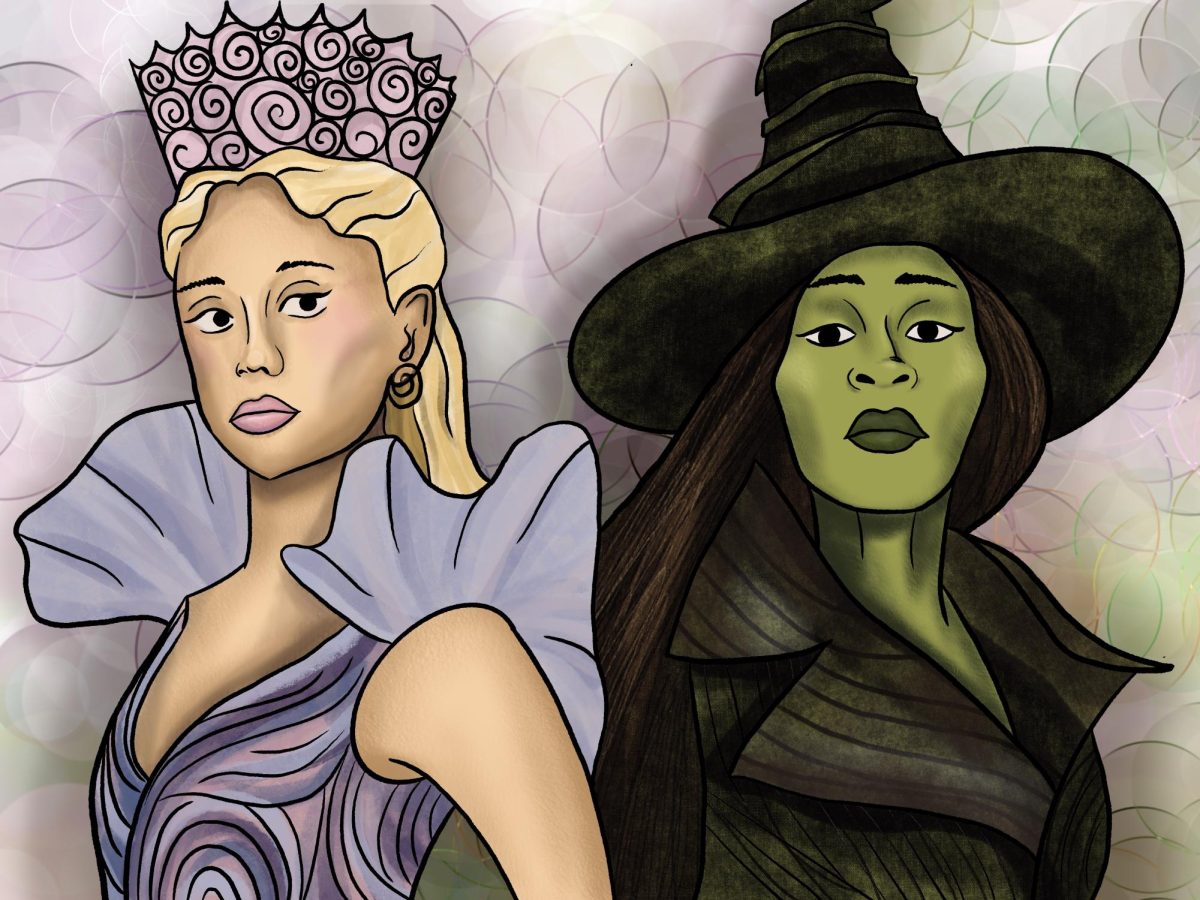
This review contains spoilers for the film.
“Wicked: For Good” delivered genuine emotional power and strong vocals while stumbling over unnecessary additions and missed directional opportunities. Where the film succeeds, it ascends, but its missteps reveal the difficulty of translating a classic stage musical to a large production film.
Highlights
The emotional core of the film stays the same: Glinda and Elphaba’s unconventional friendship.
The devastating goodbye for the two main characters, through the song “For Good,” was masterfully done, doing the original recording justice. Cynthia Erivo and Ariana Grande — who star as Elphaba and Glinda, respectively — delivered such an emotionally moving and heartbreaking performance that tears were inevitable.
What makes this song so powerful is that everyone can recall a memory this song recaptures — two people under difficult circumstances who chose to forgive one another because their mutual love means pride will never take priority over protecting the other, even if it means losing the friendship.
Another stand-out number was Grande’s “I’m Not That Girl (Reprise),” brilliantly played on “I’m Not That Girl” from the first movie, except the roles are reversed. We see Glinda’s realization that she has always been the second choice to Elphaba all along (to the Wizard, Madam Morrible, and Fiyero), which contrasts with her outward appearance of perfection and happiness.
She loved her fiancé, Fiyero (Jonathan Bailey), the only way she knew how to, forcing him into an engagement and putting him on a pedestal, but it was never what he wanted. Now he is not only in love with another woman, but it is her old best friend, Elphaba.
The staging for this scene — an empty, softly decorated pink, wrecked wedding venue where he left her at the altar — was one of the most impactful moments because of her pure heartbreak.
Soon after, we are gifted with my personal favorite number in this film, “No Good Deed.” Fiyero has just proclaimed his love for Elphaba, but she is captured, so he lets himself be caught, beaten, and crucified to give her a chance to escape.
This scene is probably the most critical for developing the film’s connection with L. Frank Baum’s original “The Wonderful Wizard of Oz” novel. Elphaba wants to save Fiyero, so she turns him into a scarecrow in the hopes that he cannot be injured without flesh, bones, or blood. Erivo delivers jaw-dropping vocals for one of this musical’s most demanding and intense scenes.
Elphaba’s emotions are perfectly captured in her rage and despair as she denounces good deeds altogether because the city of Oz refuses to recognize them. This is the Elphaba we need, the villain that everyone kept framing her as — strong, furious, and broken.
Lows
Unfortunately, the new additions to the movie fell flat.
The song “No Place Like Home” was unnecessary, as it did not develop any emotional or plot advancements despite its grab at “The Wizard of Oz.” Elphaba tries to rally the animals, but they do not listen, revealing no plot points, and the Lion’s introduction could have easily happened in “The March of the Witch Hunters.”
Similarly, “The Girl in the Bubble” feels like it was purely filler and full of cliches. The point of the song is to show that Glinda is finally ready to leave behind her superficial life, understanding that she needs to be genuinely good.
But the analogies to a bubble, lines like her wishing that “she could float on,” and ending the song on “It’s time for her bubble to pop,” make the song less serious than the tone it tried to portray. Moreover, this same message could have been communicated in a few lines, or just by her actions — no need for another three minute and 40 second song to be added to a movie already past two hours.
The staging for the song “As Long as You’re Mine,” the pivotal romance song in the musical, did not translate well onto the film. While the actors had chemistry, watching them profess their love by belting it directly into the face of the other gave me second-hand embarrassment.
It also lacks in angst, desperation, and the overall atmosphere of the original moonlit bog in the stage play. Instead of feeling intimate, the brief trip to Elphaba’s shack barely registers their relationship.
The film’s biggest narrative weakness was its handling of Fiyero’s capture.
What should have been a devastating and shocking plot twist with the transition to the song “No Good Deed” was instead underwhelming and anticlimactic, undermined by only black and white flashbacks of his crucifixion, which seemed lower-quality than the rest of the movie and unserious for the weight of the moment.
In the play, his capture is smooth and immediately displays his shape being hung up and laid as the scarecrow in a field, allowing the audience to connect the dots for themselves. This film took the opposite approach again and again with extra songs, cliche staging, lyrics, and outright filler that don’t allow the audience to make connections for themselves.
It is spelled out too clearly, making everything feel obvious and slow to watch.
Even Jeff Goldblum’s “Wonderful,” which is included in the stage musical, leaves out the depth of emotion present in the original, when the Wizard refers to the tornado and implies his involvement in the house that crushed Elphaba’s sister, Nessarose Thropp (Marissa Bode). This prevents him from truly seeming like a villain, instead glossing over the sinister nature of his actions and painting him merely as an opportunist.
Speaking of villains, another new musical addition, “The Wicked Witch of the East,” is added, detailing how Boq (Ethan Slater) is turned into the Tin Man. Sure, Nessa becomes a villain, but that concept did not need a three minute and 24 second song to be expressed. Also, like the Lion, the Tin Man did not need a full-fledged song to be introduced — it could have easily happened in “The March of the Witch Hunters,” where the Tin Man, Lion, Scarecrow, and Dorothy set off to find Elphaba.
Final Thoughts
Overall, this movie was not a waste of time; it was just disappointing.
It portrays what it needs to in order to tie off the plot of the original movie and reflect the stage play, but it is far from perfect. “For Good” recenters the true story at the end, focusing on the relationship between Glinda and Elphaba, but much of the rest is just filler and noise.
Clocking in at two hours and 18 minutes, this movie was mostly just noise, and the whole franchise should have been encapsulated in just one film. Honestly, the promo, waiting to release it a year later, and the addition of three mediocre songs just feels like a money grab, souring what is otherwise a meaningful and heartfelt story.








Comments are moderated, and won't appear until they are approved. An email address is required, but won't be publicly displayed. The Falconer's complete comment policy can be viewed on our policies page.