

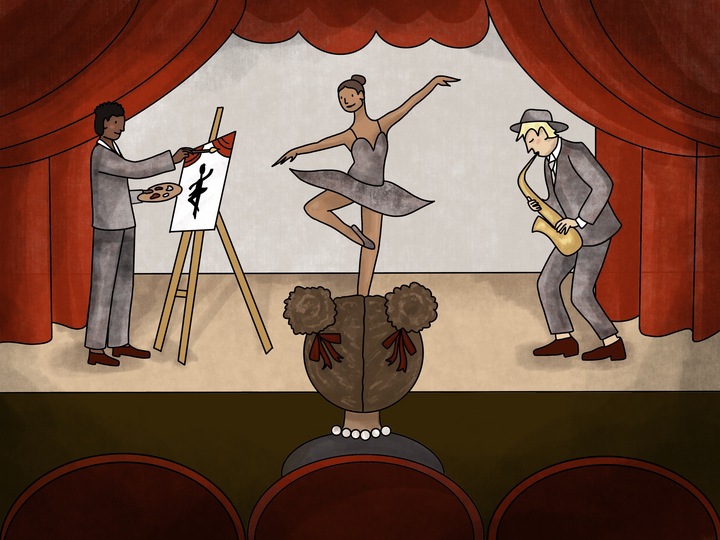
Filled with music and laughter, the lobby of the Keller Auditorium was alive the evening of Friday, Dec. 5 as people of all ages packed into the building for the opening night of the Oregon Ballet Theatre’s “The Nutcracker.”
Christmas songs floated across the lobby from where a group of carolers sang in the candlelight. Friendly vendors sold generous helpings of warm, candied hazelnuts. Sleepy children held their parents’ hands as they headed down the aisles.
Walking back to my seat after intermission, I heard a girl ask, “Why are we even here, mom?”
Yeah. Why?
It’s a fair question — one worth asking when instead, you could be home in your pajamas, scrolling through your phone with a cup of hot cocoa. Why drag yourself out on a cold December night to watch a story you’ve seen dozens of times before?
Why is art so important?
Because it isn’t optional. Look at the oldest stories we have — not written in words, but painted on cave walls tens of thousands of years ago. Our ancestors, who spent their days hunting and surviving, still found time to press their pigment-stained palms against cold stone and paint what they saw.
Art has always been an essential part of our identity, woven into the fabric of what makes us human. Our limitless capacity and drive for creation and innovation — that’s not just a nice bonus feature. It’s a core aspect of who we are.
And it’s not just about individual expression; humans are remarkably social creatures, and that tendency is no better shown than in our love for sharing the arts. Our theaters, concert halls, galleries, and museums are testament to a desire for connection and community — a need to share a part of ourselves with those around us. It’s how we bond and communicate through generations.
Art and the places that allow it to persist are the soul of our species.
But during COVID, with most people avoiding these gathering places, the arts sector took a figurative nuke it still hasn’t recovered from. The pandemic resulted in many creative hubs like theaters being shut down, causing unemployment en masse.
In virtual isolation, mental health during the pandemic nosedived as well, especially among young people. The World Health Organization reported that anxiety and depression increased by 25% worldwide during the first year of COVID-19, with youth most severely affected — a trend that has not yet healed.
That age is precisely when we’re supposed to be out there, figuring out who we are and where we fit in the world. When the gathering places waned from our lives, so did a crucial outlet for that exploration.
It’s why the arts aren’t just nice to have — they’re necessary. A 2024 study found that positive health effects were associated with as little as 30 to 60 minutes of sustained weekly participation in performing arts.
Half an hour. The average teenager spends over nine times that on social media per day. But unlike doomscrolling, those thirty minutes return something tangible: a sense of purpose, a community, a way to process what you’re feeling without having to put it into words.
And beyond that, it’s a new way to see the world.
Art offers a look into other people’s souls in a way you never could through simple conversation. You can hear the same story a million times and still be surprised when the curtain rises.
Take “The Nutcracker.” Since it was written in 1892, the ballet has been performed hundreds of thousands of times and in almost every country, and it is a time-honored Christmas tradition in many.
But attending a performance, you get the unique opportunity to see the ballet through another person’s eyes — to step into their universe for an hour or two. The National Ballet of China’s “Nutcracker” features a Crane Goddess and dragons instead of mice; South Africa’s Joburg Ballet is often set in the Kalahari desert; many local U.S. versions place the characters in colonial America or the Jazz Age.
Everyone who touches the piece infuses it with a part of themselves: the dancers, the creative directors, the producers, and even the audience.
Performance art isn’t just a solitary contribution, it’s a community effort. These places depend on us to keep them alive not just for them, but for our collective wellbeing. When you go to the theater, a museum, or a concert, you’re not just paying for a show; you’re paying to uphold a crucial pillar of society.
So go support your community. See movies, concerts, plays — but don’t overlook what’s right in front of you. Take advantage of what our school offers: art classes, clubs, theater productions, band concerts, and choir performances.
And if you’re worried about cost, don’t be. So much in the city is free for youth — museums, galleries, and performances designed specifically so money isn’t a barrier.
The only thing standing between you and these experiences is your willingness to be present.
That’s what it’s all about. That’s what it’s always been about — music, laughter, food, community. Letting people see you and share a bit of themselves in return.




Chris Babinec • Mar 19, 2026 at 1:13 pm
Bravo! I want to throw roses on the stage to celebrate this article! Art is essential!