


Bad Bunny walked into the Super Bowl with a target on his back and a Grammy in his hand.
One week before Super Bowl LX’s halftime show, he made history at the Grammys with his 2025 release, “DeBÍ TiRAR MáS FOToS,” the first-ever Spanish-language record to receive Album of the Year. Upon accepting his award — before thanking God, his mom, or any of the other reception speech cliches — he declared to the crowd “ICE out.”
The backlash to his selection as this year’s halftime show performer had started months earlier.
President Donald Trump called his selection for the Super Bowl “a terrible choice” in an interview with The New York Post, saying it would “sow hatred.” Conservative commentators questioned whether a Puerto Rican artist performing in Spanish even belonged at America’s game. Puerto Rico is a U.S. territory, and Puerto Ricans are American citizens, but that fact didn’t stop the criticism.
By game day, the controversy had intensified. Director of Homeland Secretary Kristi Noem told conservative podcaster Benny Johnson that ICE would be “all over” Levi’s Stadium in Santa Clara, California.
It seemed like as soon as his name was announced, the pressure was mounting against him. In criticism of a Spanish performance, Turning Point USA — a nonprofit founded by Charlie Kirk and Bill Montgomery in 2012 — released a counter-halftime show on Youtube with Kid Rock, encouraging viewers to tune into their show instead of a Spanish performance at the biggest American sporting event.
Turning Point USA’s performance — the “All-American Halftime Show” — peaked at about six million concurrent YouTube viewers.
Bad Bunny’s show, on the other hand, performed almost entirely in Spanish, reached 128.2 million, the fourth most watched halftime show in history.
No matter what he actually said, that simple fact made its own statement.
The Performance
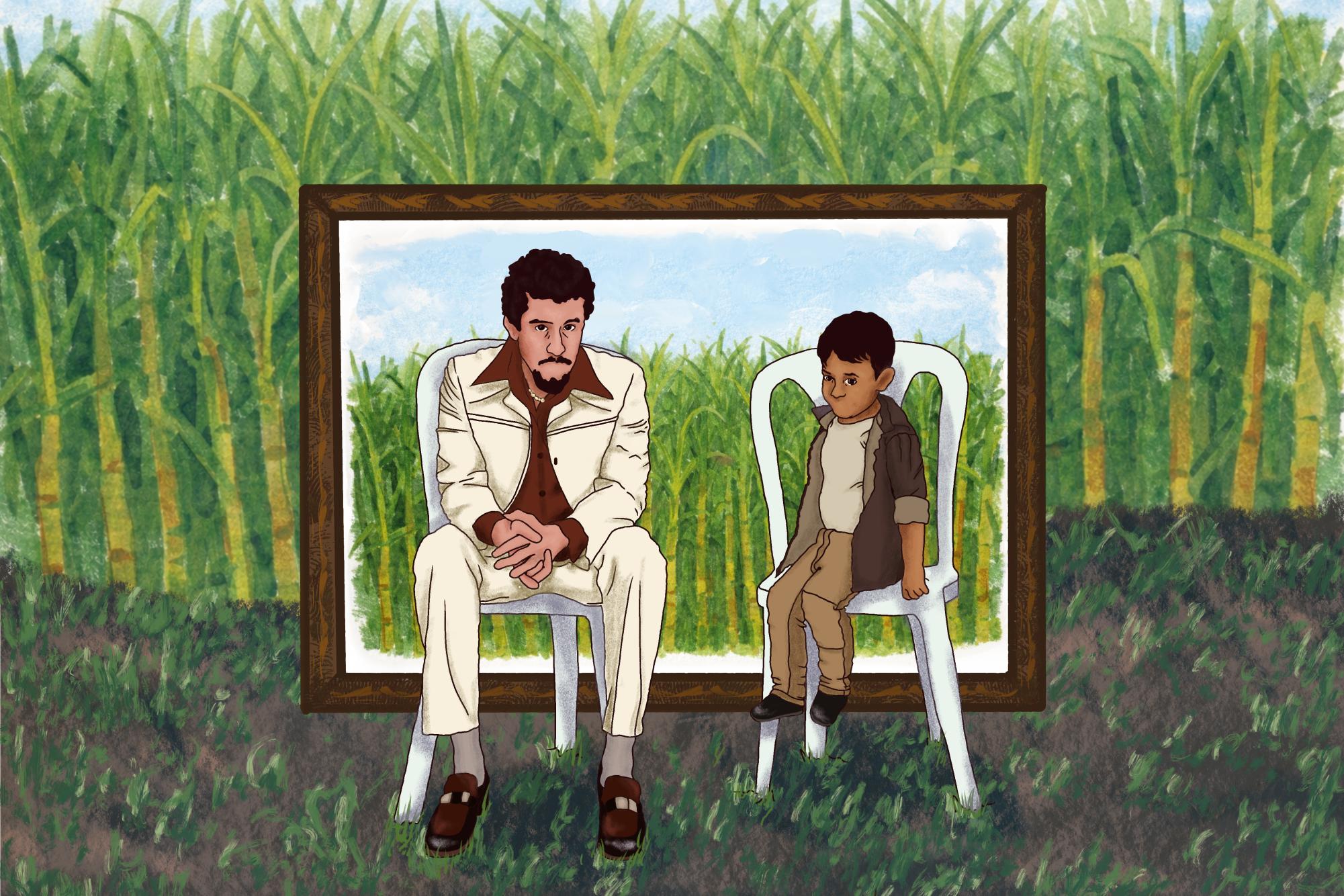
The show opened with a wide shot: a farmer in a traditional pava hat standing in a sugar cane field. The crop was introduced to Puerto Rico by Spanish colonists, which later became a major means of exploitation and enslaved labor.
“Qué rico es ser Latino,” he said in Spanish, translating to “how wonderful it is to be Latino.”
Then the camera cut to Levi’s stadium, where the dense turf had vanished under tall green sugarcane stalks — in actuality, not props or set pieces, but instead 380 real actors dressed as plants, the costumes weighing 40 to 50 pounds each. It was a comical and clever way to get around the NFL’s limits on the number of large carts allowed on the field to protect the natural turf, and it helped transform the California stadium into rural Puerto Rico.
Bad Bunny emerged from the vegetation in white — a Zara jersey cropped above the waist, “OCASIO 64” across the back. The number honors his late uncle, Cutito Ocasio, born in 1964, who taught him much of what he knows about football, but sadly passed away in 2024. Bad Bunny said he had always hoped to take his uncle to the Super Bowl but never got the chance.
He dedicated his performance to his uncle, he also said.
And it wasn’t just Bad Bunny in white. Everyone else was head-to-toe too: sugar cane farmers, shop vendors, boxers, and domino players — all dressed in ivories and creams.
The main pop of color standing out consistently throughout the show was the rich, rural landscape of Puerto Rico that Bad Bunny aimed to emulate. This created a striking contrast: figures traversing through the green landscape like old photographs coming to life.
I was struck by how the colors looked akin to a developing Polaroid, the background metabolizing quicker than the people, leaving little white outlines where they’ll soon appear. It put emphasis, artfully, on the culture rather than the individual performers — Bad Bunny included.
The entire set pays homage to the cover of “DeBÍ TiRAR MáS FOToS” through this contrast of whites and greens — the title translating to “I Should Have Taken More Photos.”
Near midfield sat La Casita, a pink and yellow house modeled after traditional Puerto Rican architecture, which Bad Bunny has used frequently in past concerts. Now it sat in California, packed with celebrities: Pedro Pascal, Jessica Alba, Cardi B, Karol G, and Venezuela baseball star Ronald Acuña Jr., to name a few. They danced on the porch and in the doorway, representing Latino diversity.
The Performance Starts
Bad Bunny’s 2022 hit “Tití Me Preguntó” opened the show, riding a Dominican dembow beat. Hundreds of dancers swarmed the field with the choreography packed to the brim with action behind Bad Bunny. As he exited La Casita, Bad Bunny gave a nod to reggaeton’s architects. A remix played, featuring Daddy Yankee’s “Gasolina,” Tego Calderón’s “Pa’ Que Retozen,” and Don Omar’s “Dale Don Dale.”
In Spanish, he told the crowd, “You’re listening to music from Puerto Rico. From the barrios and the projects.”
Then came “Monaco,” with dozens of violin players appearing from the sugarcane. Bad Bunny stopped and spoke directly to the audience in Spanish.
“Mi nombre es Benito Antonio Martínez Ocasio, y si hoy estoy aquí en el Super Bowl 60, es porque nunca, nunca dejé de creer en mí,” he said. “Tú también deberías de creer en ti. Vales más de lo que piensas. Confía en mí.”
This translates to, “My name is Benito Antonio Martínez Ocasio, and if I’m here today at Super Bowl 60, it’s because I never, ever stopped believing in myself,” he said. “You should also believe in yourself. You’re worth more than you think. Trust me.”
One of the final sets featured electrical poles and utility workers. Bad Bunny climbed one during “El Apagon,” meaning “The Blackout,” a song directly addressing Puerto Rico’s history with power grid failures. In 2024, an extreme outage on New Year’s Eve left nearly 80% of the island in total darkness.
Surprise Guests
Albeit cliché, unexpected celebrity cameos are always a treat.
Ricky Martin walked out unannounced. The 54-year-old Puerto Rican pop star, who helped bring Latin music to mainstream America in the late ‘90s, sang “LO QUE LE PASÓ A HAWAii,” meaning “What Happened to Hawaii.”
The song compares Puerto Rico’s gentrification crisis to Hawaii’s, where wealthy mainlanders have bought land and displaced locals. One week earlier, Martin had written an op-ed in Puerto Rican newspaper El Nuevo Día celebrating Bad Bunny’s Grammy win.
“Benito, brother, seeing you win three Grammy Awards, one of them for album of the year with a production entirely in Spanish, touched me deeply,” he wrote. “You won without changing the color of your voice. You won without erasing your roots. You won by staying true to Puerto Rico.”
Later, Lady Gaga played a singer during a wedding scene, performing “Die With a Smile” — her duet with Bruno Mars — reimagined as salsa with LoS SOBRiNOS, the Puerto Rican band from Bad Bunny’s album.
Lady Gaga and Bad Bunny have a documented history of mutual fandom, and honestly, it’s pretty adorable to see.
He openly adored her 2020 release, “Chromatica,” and repped her merch for the album in the same year. She introduced him on “Saturday Night Live” in 2023, and last September, she told “¡Despierta América!” that she’s “actually a very big Bad Bunny fan.”
At the Grammys, one week before the Super Bowl, cameras caught Lady Gaga surprising Bad Bunny from behind, causing him to jump and throw his head back in delight.
A Real Wedding
While Bad Bunny pranced around the sugar cane fields in the beginning of the performance, in the background, you could spot a couple proposing to one another, then later in the show, holding a wedding ceremony.
But that couple getting married wasn’t just for show — it had real vows, a real ceremony, and it was legally binding.
Tommy Wolter and Eleisa Aparico, engaged at Cannon Beach, Oregon, in October 2024, had invited Bad Bunny to their wedding. He couldn’t make it — Super Bowl and all — so he invited them to get married during his show instead. Bad Bunny even signed their marriage certificate.
The couple cut a three-tier cake and kissed while performers cheered. Lady Gaga and Bad Bunny danced a short salsa routine together, then transitioned into his song “BAILE INoLVIDABLE.”
The Grammy
A living room set appeared. An old TV showed Grammy footage. A young boy sat between two adults, watching.
Bad Bunny walked in and handed the kid a Grammy replica. “Always believe in yourself,” he said.
The boy was Lincoln Fox Ramadan, five years old, half-Argentinian, and dressed to look like a young Bad Bunny. His mother, Erika Ramadan, told The New York Times that the family had driven from their home in Costa Mesa, California, to the Bay Area in late January for rehearsals.
Social media immediately speculated he was Liam Conejo Ramos, a child detained by ICE who was wearing a Spider-Man backpack, but these claims were disputed. The symbolism didn’t need a specific face, however, just the idea that any Latino kid watching could see himself there.
“God Bless America”
Near the show’s end, Bad Bunny stopped. He looked at the camera and spoke in English — for the first time all night.
“God bless America,” he said.
Then, he switched back to Spanish and began listing countries that are part of the Americas — Chile, Argentina, Venezuela, the United States, and Canada to name a few, all said in rapid succession. It was a roll call of countries across Latin and Northern America, and it did what it set out to do: unite.
Dancers followed carrying flags from each country mentioned. The Puerto Rican and American flags were most prominent, but not alone.
He held up a football. “Together we are America,” he said, and spiked it.
One of the talking points emphasized by ring-wing commentators and politicians since the halftime show performer announcement has been driven by the simple, incorrect idea that Bad Bunny — along with his country and culture — are not American.
This criticism capsizes pretty quickly when you stop to consider two facts:
The first is that Bad Bunny, legally speaking, is a U.S. citizen. Puerto Rico — where Bad Bunny was born — is a U.S. territory.
The second is that we’ve allowed non-Americans to perform at the Super Bowl before, and we did so with a lot less fuss. As of this year, 13 non-Americans have performed prior to Bad Bunny.
But those previous performers were doing so in a very different political climate. More than anything, the chaos surrounding this halftime show emphasizes just how polarized we are as a country at the moment.
We are more divided than ever right now, and so many people anticipated this performance to even further cleave the country into opposing sides.
Instead, Bad Bunny did everything he could to unite America.
The stadium screen blazed behind him, reading in all caps, “The Only Thing More Powerful Than Hate Is Love.”
“We’re still here,” he said one final time in Spanish.
The closer was “DtMF,” a song about nostalgia and culture slipping away. “I should have taken more photos,” the lyrics said in Spanish. He sang it surrounded by flags and sugarcane and dancers in white.
Then it ended.
The Aftermath
Trump was on Truth Social before the field even cleared.
“The Super Bowl Halftime Show is absolutely terrible, one of the worst, EVER!” he said in a post. “Nobody understands a word this guy is saying, and the dancing is disgusting, especially for young children.”
The show, despite the many people who opposed it, made history. In 60 years of Super Bowls, a show had never been performed in a language other than English. Now it has.
It was a halftime that was hard not to enjoy — bright, fun, and poignant when it needed to be. The visuals worked, the sugarcane and white costumes created a strong aesthetic, and the musical selections balanced hits with cultural depth.
But the show could’ve pushed harder, and I wish it did.
The Trump administration had given him plenty of ammunition — ICE raids, deportations, and constant taunting. Bad Bunny mostly responded with gestures and celebration instead of direct confrontation. The show often pointed at the politics without diving in.
However, while not as direct as I’d wished, the performance did what it set out to do, and it did so well: it celebrated culture and the people that made that culture happen.
It aimed to unite people — to make them feel represented, heard, and cherished — not divide them further and further apart. At a time with so little bipartisanship, so much polarization, and so much political upheaval, honestly, we needed a party.
For 13 minutes, America came together.







Comments are moderated, and won't appear until they are approved. An email address is required, but won't be publicly displayed. The Falconer's complete comment policy can be viewed on our policies page.