


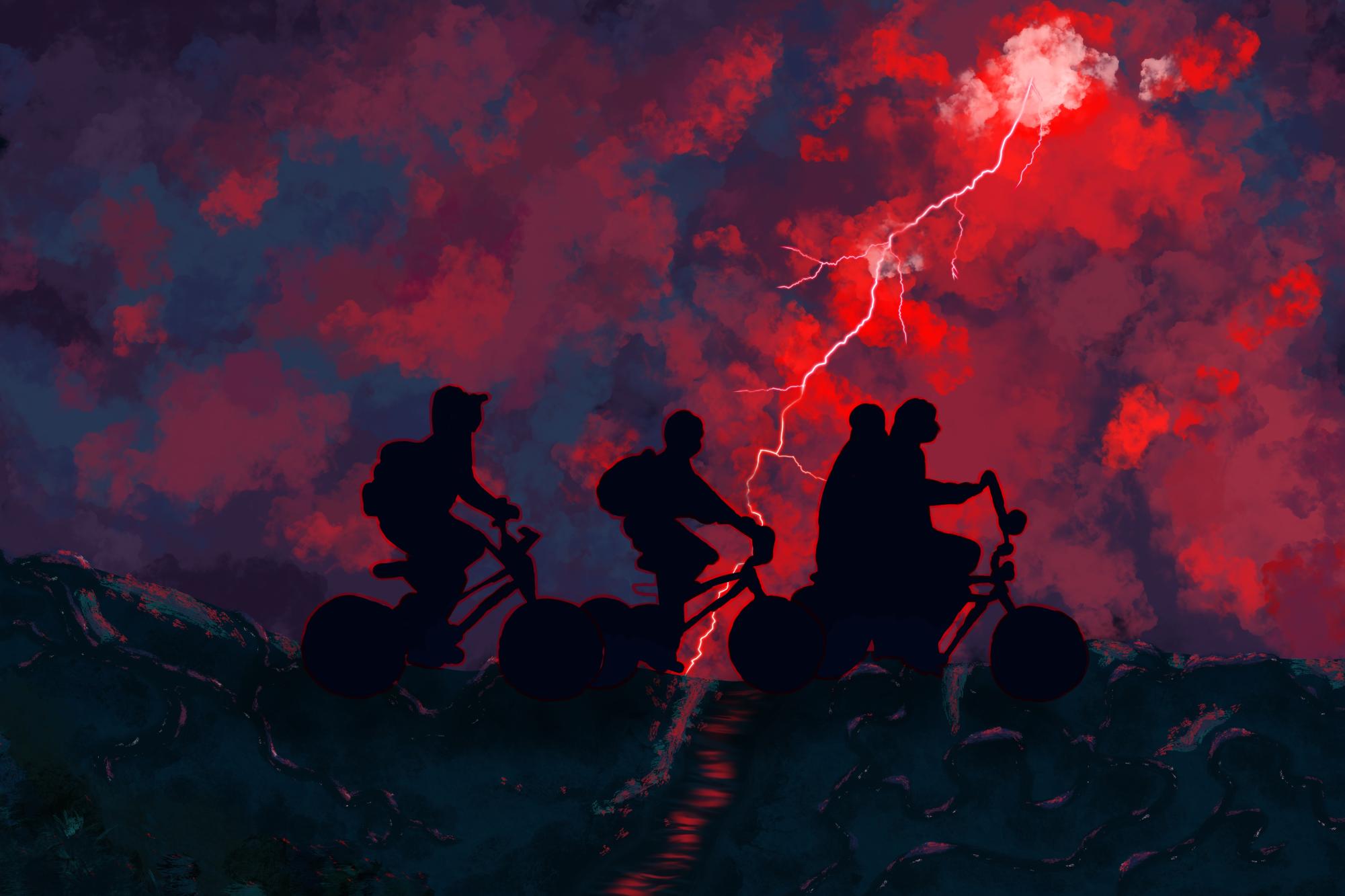
This review contains spoilers for the series.
Following its release in 2016, “Stranger Things” swiftly rose to global popularity, garnering millions in viewership and revenue.
But as it became more of a phenomenon, “Stranger Things” has followed a dismaying — and familiar — path. Every season, the series has slipped further into the oversaturation and shallowness that characterizes much of recent media with comparable commercial success.
Capitalizing on the holiday season, the first four episodes were released on November 26, the next three on Christmas Day, and the series finale on New Year’s Eve. Already, Matt and Ross Duffer, the show’s creators, have confirmed two spin-offs in the works.
I say don’t bother, if they’re going to be anything like this season.
There is one word that describes the fifth and final season of “Stranger Things”: disappointment.
Each episode was more frustrating than the last, culminating in a two-hour-long mess of nonsensical engagement farming.
It’s like the Duffer Brothers took the TikTok sound bites of all the previous seasons and copy-pasted them into every scene, stripping away the depth and context that made those moments so impactful in the first place.
Practically all plot and character exhibition is diminished to clever remarks and flippant one-liners. It’s soulless and insulting, especially to the characters and the brilliant actors that play them.
As much as I love Robin (Maya Hawke), all she does in this season is quip. And despite the range he displayed as Will in seasons one and two, Noah Schnapp delivers what feels like a single set of lines in most of his scenes — dramatic, often redundant warnings. There’s only so many times Will can say some variation of, “He’s back” before it begs an eye-roll.
The show has always leaned into the archetypes of its characters, but season five pigeonholes practically everyone into those stereotypes.
The Duffer Brothers refuse to let characters grow.
For example, despite their individual arcs and heartfelt reunion, Eleven (Millie Bobby Brown) and Hopper (David Harbour) clash constantly as they did in seasons two and three. Even Hopper’s emotional monologue in the finale to Eleven is oddly reminiscent of his speeches to her in the finales of seasons two and three, centering around his fear of losing her and the loss of his biological daughter, Sarah.
Their development as characters is largely ignored in favor of reprising what worked from previous seasons, rehashing speech after tired speech.
That’s one thing that this season has entirely too much of: dialogue. The skill of showing rather than telling is something the writers have evidently lost, with every plot twist and character detail requiring a witty line or a long-winded monologue.
In season one, viewers are shown a montage of different characters getting ready for Will’s funeral. We then see Jonathan (Charlie Heaton) getting dressed alone and eventually giving up on his tie, frustrated.
He’s alone because Joyce is too much of a mess to help him and doesn’t believe Will is dead anyway. Jonathan is trying to get ready for his little brother’s funeral that he planned by himself at 16, but he can’t finish getting dressed because his dad never taught him how to tie his tie.
With no dialogue, that scene holds more weight, nuance, and insight than this entire season.
Remember when you actually cared about the characters? It’s because the writers spent time on them and created scripts that you could interpret and connect to. I could believe that each character was a real person because they did real things, thought real thoughts, and struggled with real human problems despite their outlandish circumstances.
“Stranger Things” didn’t write humans this season — they wrote tools to move the plot forward.
Far more often than not, the writing was just too shallow for me to connect with it.
However, amid the muck of the rest of the season, the respective character development of Dustin (Gaten Matarazzo) and Steve (Joe Keery) shone through. Dustin is a scared, grieving kid who doesn’t want to lose anyone else. Steve is an emotionally inarticulate pseudo-parent who often chooses the party’s safety over his own.
Matarazzo and Keery played their respective roles beautifully — there’s a reason their characters are consistent fan favorites. Their tension and eventual reconciliation were a joy to watch this season, and their scenes were the only ones to make me tear up.
I was the most surprised by Jamie Campbell Bower, who plays Vecna, the series’ lead villain. While his acting as Henry, Vecna’s more human form, has been especially stellar since his introduction, in the finale, his presence and complexity absolutely blew me away.
In his key scene, where Henry is reliving his most traumatic memory, Campbell Bower filled the screen with such carnal rage and pain that I got chills. Paired with Raphael Luce, who plays young Henry, this scene was viscerally electric. I’m beyond excited to see more of both actors.
The gold mine that is this cast makes the final product that much more infuriating. It doesn’t matter how great an actor is if their talents are held prisoner by bad writing and worse execution.
Part of what made the first season so captivating was its atmosphere. Its instantly iconic soundtrack, brilliant lighting design, and expert subtlety engineered an atmosphere of suspense, more because of what you didn’t see than what you did.
Now, absolutely everything is thrown in the viewer’s face — said aloud and accentuated with a flash of gaudy red-40 lightning. Netflix got so comfortable with its success that it abandoned the mystery and tension that made the show so explosive in the first place.
Rather than emotional depth, atmosphere, or complex story structure, season five relies on its already massive fan base and obnoxious 80’s references for cultural impact.
As much as I love “Stranger Things,” it’s just not the same show.
If a viewer is looking for things to be happy about, then they will enjoy this season — there’s no doubt that it’s entertaining. But taking a critical stance, season five is weighed down by gaping plot holes, one-dimensional characters, and unimaginative writing.







Comments are moderated, and won't appear until they are approved. An email address is required, but won't be publicly displayed. The Falconer's complete comment policy can be viewed on our policies page.