


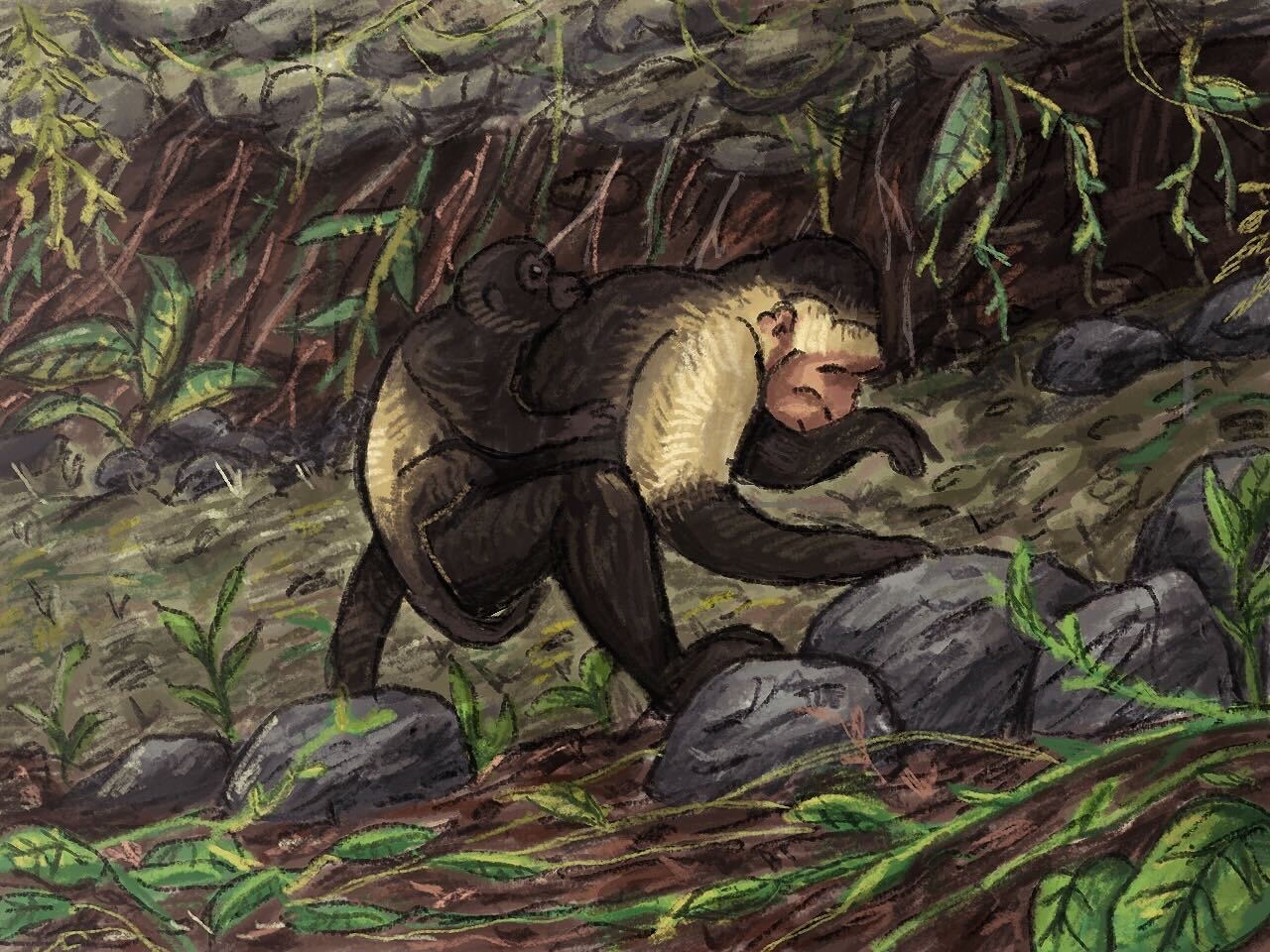
On Jicarón Island, 30 miles off the coast of Panama, researchers from the Max Planck Institute captured footage of something many of us wouldn’t bat an eye at: an adolescent monkey carrying an infant monkey on its back.
The only thing is, that infant is not on its mother’s back — nor its father’s, its sister’s, or its brother’s. In fact, the two monkeys aren’t related in the slightest — not even by species.
The carrier was a male capuchin monkey, the infant a howler monkey, and since the research was published on May 19, scientists have been stumped.
Males don’t typically carry babies at all, let alone babies from another species. But this particular capuchin didn’t seem to care about normal monkey etiquette. Over the following months, he collected four different howler infants, all under four weeks old. His buddies, apparently impressed by his new hobby, started copying him.
Now, you might think this sounds sweet — monkeys playing adoptive parent across species lines.
It’s not.
Capuchins have no clue how to care for howler babies. These infants need their mothers’ milk to survive, and last time anyone checked, adolescent male capuchins don’t lactate. Every single baby died.
But here’s what makes this story even stranger: this wasn’t predation. The researchers found no signs of aggression, no evidence that the capuchins were planning to eat these babies. It wasn’t a competition between the males — no scorekeeping, no winner. The capuchins were gentle with the infants, sometimes even continuing to carry babies that had already died from starvation. They weren’t trying to hurt anyone. It appears they just liked carrying them around.
A cultural tradition of recreational kidnapping had emerged, spread through social learning, and it served absolutely no survival function.
And it happened in what could be described as a monkey paradise, a thriving ecosystem where these capuchins had developed stone tools, a form of ingenuity their mainland cousins hadn’t yet figured out.
Why?
Jicarón is an island free from predation. The capuchins sit at the peak of the food chain, and without threats lurking nearby, survival stops being the primary concern. There’s time to think, to experiment, to explore behaviors that serve no obvious purpose. The simplest explanation for their stone-age advancements?
That detail turns this story from simply disturbing to fascinating. The same capuchins who invented deadly baby-kidnapping also figured out how to make stone tools. And we’re not talking about accidental rock-banging here — these monkeys have cracked the code that took human ancestors millions of years to master.
They pound rocks together with purpose, creating sharp flakes they use to crack open nuts and shellfish. It’s the kind of behavior that challenges archaeologists’ assumptions: those stone flakes look suspiciously similar to tools early hominins were making 3.3 million years ago — the very artifacts we’ve used to trace human cognitive evolution.
If monkeys can make them too, can we still point to stone tools as evidence of early human intelligence?
Whatever capacity allowed them to develop a culturally transmitted practice of recreational kidnapping also have led them to join the exclusive club of tool-using primates. Both behaviors emerged from minds that had solved all the basic problems of monkey existence — food, water, safety, continued reproduction — and seemed to be looking for something, anything, to occupy their free time.
Sometimes that restlessness can lead to innovation. Sometimes it can lead to cruelty.
The capuchins reveal something most of us would rather not think about: intelligence is inherently restless. When intelligent beings have their basic needs met, their minds don’t just relax and enjoy the good life; they start experimenting. They innovate. They create complexity where none existed before.
The problem is, they don’t necessarily always create good complexity.
What we’re looking at here is cognitive surplus in action — mental energy with nowhere productive to go.
We love to think that boredom is a modern problem, something that emerged with smartphones and suburban life. But the capuchins suggest otherwise. Boredom isn’t a bug in the system of consciousness. Boredom is a feature. It’s what happens when intelligent beings master their environment well enough that survival stops being the primary concern.
The tragedy of the Jicarón capuchins isn’t that they became bored when their survival needs were met, it’s that they’re unable to distinguish between complexity that solves problems and complexity that creates them. They lack the ability to evaluate their own innovations.
This is where humans have what might be our most important evolutionary advantage.
We can recognize when our minds are just making stuff up to stay busy. We can pause and ask ourselves: is this complexity I’m creating actually useful, or am I just generating drama because regular life feels too predictable?
The capuchins can’t make that distinction. They follow whatever impulse feels most engaging, no matter the consequences. They’ve created a perfect case study in what happens when intelligence operates without wisdom — when the capacity to innovate isn’t paired with the judgment to innovate well.
Every major human breakthrough, from fire to the wheel to the internet, emerged partly from minds that had moved beyond immediate survival concerns. When basic needs are handled, intelligence doesn’t shut down. It explores.
Boredom becomes the psychological space where genuine progress happens.
But that same restless creativity can just as easily produce harm. The difference isn’t in the initial impulse — that drive for complexity and novelty — but in what we choose to do with it.




Daniel Garbitelli • Oct 16, 2025 at 8:39 pm
You know whats funny is that sometimes I think that we as humans don’t know how to evaluate our own innovations. Think about it. We didn’t need AI except for the vague goal of “improving efficiency”. Now we have a whole host of problems becuase of AI and not as many benifits. We didn’t need to resurrect the dire wolf. Like the scientists in Jurassic Park, we are so busy trying to figure if we can do something before we stop and ask if we should. A very interesting article that I think sparks many questions and conversations.